By Ali Badi | CEO & Credit Risk Strategist, ADR Wealth Advisors LLC 16 min read
Table of Contents
- Why the "3 to 6 Months" Answer Is Misleading
- The 5 Phases of Credit Building — From Zero File to Fully Fundable
- No File vs. Thin File vs. Established File
- The Reporting Cycle — Why Your Score Isn't Updating
- The Authorized User Strategy — How It Really Works
- What a Former Bank Underwriter Looks for Beyond the Score
- How to Build Credit from Scratch — Legitimate Acceleration Strategies
- Building Business Credit on a Parallel Track
- Realistic Credit Score Timelines by Goal
- The Bottom Line
- Frequently Asked Questions
If you search "how long does it take to build credit from scratch," you will find the same answer on every major financial site: three to six months.
That answer is technically correct. It is also almost completely useless.
Three to six months is how long it takes to generate a score — a number that appears when a lender pulls your file. It says nothing about whether that number is high enough to matter, whether your file is deep enough to support an approval, or whether the credit you've built actually qualifies you for anything worth having. How long credit takes to build depends entirely on what you want it to do — and that is the question this article actually answers.
I spent years reviewing credit files as a bank underwriter. I have seen applicants with scores in the 680s get declined because their file was too thin to support what they were asking for. I have also seen lenders stretch for borrowers with 640s because their payment history was clean, their utilization trend was moving in the right direction, and their file told a coherent story.
The score is the door. The file is what is behind it.
This article gives you the real timeline — not the one that sounds reassuring, but the one that maps to what you're actually trying to accomplish. Whether you're asking how long it takes to build good credit for a car loan, how long it takes to get a good credit score for a mortgage, or how long it takes to reach a credit readiness milestone as a business owner, the answer is different for every goal. And the path is longer than most people expect.
Why the "3 to 6 Months" Answer Is Technically True and Practically Misleading
Let's start with what the 3-to-6-month timeline actually refers to.
FICO — which stands for Fair Isaac Corporation — requires two conditions to be met before a score can be generated from your credit file. You need at least one account open for six months or more, and at least one account that has reported activity to the credit bureaus within the past six months. Meet both conditions, and a FICO Score can be calculated. Miss either one, and you get no score at all. When do you get a credit score? Exactly when those two conditions are satisfied — not a day before.
FICO Score 8 is the most widely used model across general credit decisions. But mortgage lenders specifically pull FICO Score 2 (from Experian), FICO Score 4 (from TransUnion), and FICO Score 5 (from Equifax) — not FICO Score 8. The score you see in a free app and the score a mortgage underwriter uses can be meaningfully different numbers generated from the same file.
VantageScore — which runs as versions 3.0 and 4.0 — is the model behind most free monitoring apps including Credit Karma. It can generate a score after as little as one month of history. But VantageScore is used by fewer than 10% of lenders in actual underwriting decisions. The score you see on Credit Karma is almost certainly a VantageScore 3.0. The score a mortgage underwriter pulls is almost certainly a FICO Score 2, 4, or 5.
Here is what nobody adds to the three-to-six-month answer: a first-time score commonly lands between 580 and 650. That range sits below the threshold for most conventional credit products. The Federal Housing Administration (FHA) requires a minimum 620 FICO for its mortgage program. Most major banks want 660 or higher for an unsecured personal loan. How long does it take to establish credit that actually functions in the real world? Longer than six months. If you want to understand what each score range actually unlocks, our breakdown of what is a good credit score number maps every tier to real lending outcomes.
A 590 score exists. It shows up on a screen. But it does not unlock much.
The real question has never been "how long until I have a score?" The real question is: how long until I have a score that does something specific for me?
The 5 Phases of Credit Building — From Zero File to Fully Fundable
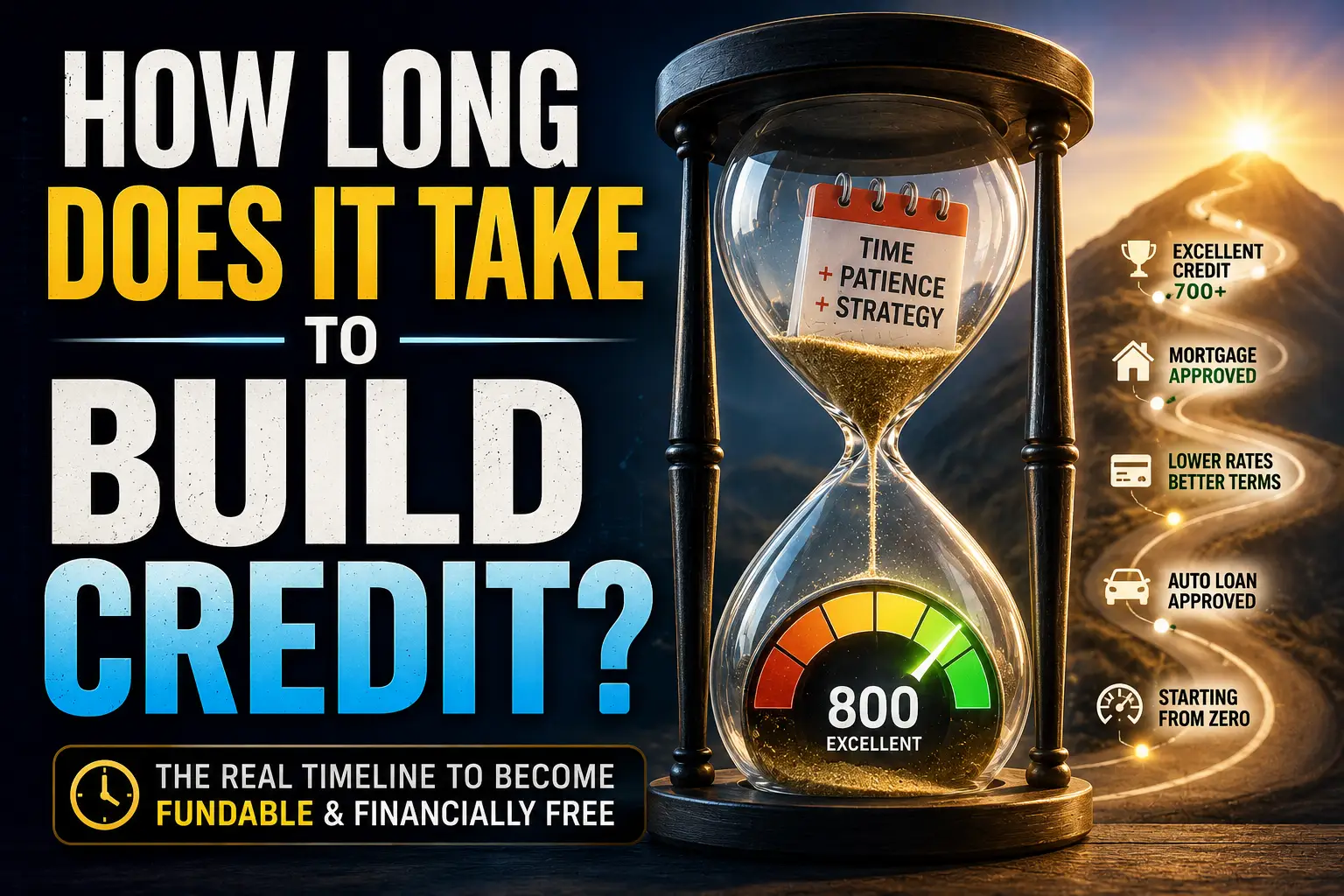
If you are asking how long to build credit at a basic functional level, the direct answer is: six months to exist in the system, twelve to eighteen months to have real options, and three to five years to be genuinely prime. Here is the full framework mapped to real outcomes at each stage.
| Phase | Timeline | Score Range | What It Unlocks |
|---|---|---|---|
| Phase 1: Existence | Months 1–6 | No score → 500s | You appear in the system. Nothing more. |
| Phase 2: Entry | Months 6–12 | 580–619 | Secured-to-unsecured upgrades, subprime auto, some FHA |
| Phase 3: Access | Year 1–2 | 620–659 | FHA 3.5% down, entry-level auto, basic personal loans |
| Phase 4: Approval | Year 2–3 | 660–699 | Most conventional lenders, better rates, real credit cards |
| Phase 5: Prime | Year 3–5+ | 700–740+ | Best rates, jumbo loans, SBA eligibility, business funding |
Phase 1 — Existence (Months 1–6) | No Score → 500s
During the first six months, your job is simply to appear in the system. Open a secured credit card — ideally one with room to grow your limit over time — get it reported to the bureaus, and let it age. If you're 18 and building credit for the first time, Phase 1 is exactly where you are right now. Not sure which card to open? Our guide to the best first credit card in 2026 compares the top options specifically for beginners with no credit history.
How long does it take to build up credit to the point where a score appears? Between four and six months for most people. Your score — if one generates at all during this phase — will land somewhere in the 500 to 550 range, reflecting your thin history.
The most common Phase 1 mistake is checking your score every three days and panicking when nothing moves. A credit score is not updated in real time. It updates when lenders report new data to the bureaus, which typically happens once a month.
Phase 2 — Entry (Months 6–12) | Score Range 580–619
A consistently managed secured card will push your score into the 580-to-620 range by the end of the first year. This range qualifies you for some entry-level products — including bad credit auto loans, some store-branded cards, and in some cases a secured-to-unsecured upgrade from your existing card issuer.
If you are starting with a 500 credit score, you are already past Phase 1 — you have a file, it just needs consistent positive data stacked on top. Getting from 500 to 620 typically takes 12 to 18 months of clean behavior, depending on what is currently suppressing the score.
Phase 2 is where impatience causes real damage. Some people open two or three new accounts in the same month, thinking more tradelines equals faster progress. What actually happens is a cluster of hard inquiries hits the file, average account age gets compressed, and the score often drops 15 to 30 points before recovering. Open one new account at a time, spaced at least three to six months apart.
Phase 3 — Access (Year 1–2) | Score Range 620–659
This is the first range where real credit access opens up. The Federal Housing Administration (FHA) sets its minimum FICO at 620 for a 3.5% down payment loan, per HUD guidelines. Entry-level auto loans from franchise dealerships become available. Some personal loan products become accessible, though rates will still be elevated. If getting mortgage-ready is your Phase 3 goal, our step-by-step guide to how to fix your credit to buy a house covers the exact preparation process lenders expect.
The key driver in Phase 3 is payment consistency. Every on-time payment is being logged as payment history — the single most important factor in your FICO Score calculation at 35%, per Fair Isaac Corporation's published methodology. A missed payment at this stage can crater a score by 60 to 90 points in a thin file. How long does it take to improve credit score progress after a single miss? Typically six to twelve months of clean behavior to recover what one missed payment costs you.
Phase 4 — Approval (Year 2–3) | Score Range 660–699
At 660 and above, the doors open considerably. Most conventional mortgage products become accessible. Auto lenders offer near-prime rates. Unsecured credit cards with meaningful limits become available. This is also where loan preparation starts to matter — having the right file structure before you apply is what separates approvals from declines at this score range.
What separates Phase 4 from Phase 3 is not just the score number — it is the file depth behind it. By Year 2, a well-managed file should have two to three tradelines, average account age approaching 18 to 24 months, and a credit utilization ratio — the percentage of available revolving credit in use — consistently below 30%. A 730 credit score is considered "good" under FICO's published score ranges and sits above the national average of approximately 714, per Experian's 2024 consumer credit data. At 730, you qualify for most prime products at competitive rates.
Phase 5 — Prime (Year 3–5+) | Score Range 700–740+
This is where your credit profile starts working for you rather than just qualifying you. At 700 and above, you are negotiating from strength — better interest rates, higher credit limits, access to business funding programs including SBA loans, and in many cases business lines of credit without a personal guarantee.
Two people can both have a 720 score and be in completely different positions with a lender. A 720 built on a two-year file with two accounts is not the same risk as a 720 from six years of managed credit across five tradelines and a clean payment history. File depth matters as much as the score itself.
Building from Scratch vs. Rebuilding Credit — The Timeline Difference {#rebuild}
If you had credit before and let it fall — medical debt, a divorce, a period of unemployment — you are not building from scratch. You are rebuilding. How long does it take to rebuild credit? The timeline is longer and harder than starting fresh, because you are fighting against existing negative data while simultaneously adding positive data.
Under the Fair Credit Reporting Act (FCRA), from the date of first delinquency. A Chapter 7 bankruptcy can remain for up to ten years. Negative items lose their suppressive effect gradually as they age and as positive data accumulates — but the clean-slate timeline does not apply to a rebuilder.
How long to rebuild credit back into a fundable range? The realistic answer is 18 to 36 months of consistent, clean behavior from the point the last negative item was added. If a dispute strategy is your path forward, our full guide to how to remove late payments from your credit report walks through every method step by step — including goodwill letters, FCRA disputes, and bureau escalation.
Rebuilding credit uses the same tools as building from scratch — secured cards, credit-builder loans, rent reporting — but those tools need to work harder because they are competing with existing negative history on the file.
📊 Not sure which phase your file is in right now? The Score Machine reads your credit file the way a lender would — account depth, utilization trend, inquiry pattern, and what each factor is actually doing to your approval odds. Check Your Credit Readiness →
The No File vs. Thin File vs. Established File Distinction Nobody Explains
Most credit-building content treats "no credit history" as a single condition. It isn't. There are three meaningfully different states, and each one requires a different approach. A tradeline is any credit account that appears on your credit report — a credit card, auto loan, mortgage, personal loan, or credit-builder loan. The number and age of tradelines is what separates these three states from one another.
No File
A no-file consumer has zero tradelines reported to any of the three major bureaus — Equifax, Experian, and TransUnion. They cannot be scored at all. No FICO Score. No VantageScore.
Building credit from nothing means starting with a blank file rather than a damaged one. This is actually a cleaner starting position than a file full of derogatories. The only disadvantage is that some lenders will decline a no-file applicant on that basis alone, even with strong income, because there is no behavioral data to evaluate.
A 350 credit score is a different situation entirely. A score that low typically indicates significant recent negative history — missed payments, accounts in collection, or a recent bankruptcy. That is not a no-file profile. It is a damaged file that needs a repair strategy before an acceleration strategy. Our practical guide to improving your credit score after bankruptcy is the right starting point for anyone recovering from that level of damage.
Thin File
A thin-file consumer has one to two tradelines, usually with limited history. The length of credit history factor — which accounts for 15% of the FICO Score calculation — has very little data to work with, which makes the score volatile. A single late payment, a utilization spike, or even the closing of one account can swing the score 40 to 80 points in either direction because there is not enough data to absorb the impact.
Most generic credit-building advice is written for thin-file consumers but almost none of it acknowledges this volatility. When someone with a thin file makes a small mistake and watches their score drop 65 points, they assume something catastrophic happened. What actually happened is the file had no buffer. This is normal at the thin-file stage — not a sign that something is permanently broken.
Established File
An established file has three or more tradelines — ideally including both revolving credit (credit cards) and installment credit (auto loan, personal loan, credit-builder loan). At this depth, the score stabilizes because individual variables no longer dominate the calculation. If you want to accelerate the move from thin to established, our guide to using tradelines for a credit boost covers what works, what doesn't, and what risks to avoid.
Getting from thin file to established file typically takes 12 to 24 months of active management. This is the most important transition in the credit-building process, and it is the one that most credit-building timelines fail to address.
The Reporting Cycle — Why Your Score Isn't Updating and What to Actually Watch
A question that comes up constantly: how long does it take for a credit score to go up after you do something right? The answer is 2 to 6 weeks — and the reason is the reporting cycle, not your behavior. How fast a credit score can go up depends entirely on when your lender chooses to report data to the bureaus, which is outside your control.
Here is how the cycle actually works.
You make a payment on your credit card. Nothing happens to your score that day. Your lender reports your account activity to the credit bureaus on their own internal schedule — most commonly around the statement close date, not the payment date. That report is then processed by the bureau, which updates your credit file. Only after your file is updated can your score reflect the change.
How long does it take your credit score to go up after you pay down a balance? The total lag is typically 2 to 6 weeks. Different lenders report to different bureaus on different schedules, which is why your Experian score and your TransUnion score can show different numbers on the same day — one bureau has received updated data that the other has not processed yet.
How fast does credit score go up after a positive action? The score does not move at all until the bureau receives the data. Paying down a card today and checking your score tomorrow will show no change — not because the payment did not work, but because the bureau has not been told yet. For a full breakdown of the fastest timing-based strategies, read our guide to how to increase your credit score quickly — it covers the 30-to-90-day acceleration window in detail.
The correct time to check your score for utilization impact is 7 to 10 days after your statement closes, not after your payment posts. Your credit utilization ratio — the percentage of available revolving credit you are currently using — is most commonly captured from the statement close balance, not from a mid-cycle payoff.
The strategic move: pay your balance down to $5 to $20 before the statement closes, so that low balance is what gets reported. Then pay the remaining statement balance in full before the due date.
A credit analysis platform that tracks reporting cycles across all three bureaus removes the guesswork from this entirely.
The Authorized User Strategy — How It Really Works (and When It Backfires)
An authorized user is someone added to another person's credit card account who gets the benefit of that account's history on their own credit file. It is a legitimate credit-building tool that can accelerate the timeline meaningfully — but only when executed correctly.
What Makes an Authorized User Tradeline Valuable
When added as an authorized user, the primary account's history is added to your credit file. Three variables determine how much value it delivers:
Account age. If the primary cardholder has held that account open for 10 years, you effectively inherit 10 years of account history. This directly impacts the length of credit history factor in your FICO Score, which accounts for 15% of the total calculation.
Utilization on the account. If the primary is carrying a high balance relative to their credit limit, that utilization appears on your file too. Being added to a maxed-out card can hurt your score. Ask the cardholder about their current balance and credit limit before accepting AU status.
Payment history on the account. Any late payments on the primary's account will appear on your file. One 30-day late from five years ago can still suppress your score. Confirm the account has a clean payment history before being added. If you are unsure how much a single late payment can drag a score, read our breakdown of — the numbers are significant.
Not every card issuer reports authorized user activity to all three bureaus. American Express, Chase, Capital One, and Discover generally do. Some smaller issuers do not report AU status at all, making the tradeline worthless for credit-building purposes. If you are still deciding which card to open in your own name, our roundup of the best credit cards for bad to fair credit covers the strongest starter options.
The Risk of AU Removal
If the primary cardholder removes you — for any reason, at any time — that tradeline disappears from your file at the next reporting cycle. If it was your oldest account, your average account age drops immediately and your score follows. AU status creates a fragile score. Use it as a supplement to building primary tradelines in your own name, not as the foundation of your credit profile.
The Tradeline Rental Problem
Some companies sell authorized user tradeline rentals — you pay a fee to be temporarily added to a stranger's account to inflate your score. FICO has algorithms specifically designed to detect and discount what it calls "piggybacking credit" when the AU has no real relationship to the primary account holder. It may produce a temporary number bump, but it does not build a fundable profile.
For legitimate and credit-building strategies, the foundation must always be accounts in your own name.
What a Former Bank Underwriter Looks for Beyond the Score
When I was reviewing credit files, the score was the first thing I looked at. It was not the last thing. The score tells you whether to look more closely at a file. The file tells you whether to approve it.
Here is what actually gets evaluated in a manual underwriting review:
Account age and file depth. How many tradelines are open? How old is the oldest account? What is the average age of all accounts? A file with four accounts averaging three years of history reads very differently from a file with two accounts averaging eight months.
Credit mix. Does the file include both revolving credit and installment credit? A file with only credit cards has no installment history — the lender does not know how you handle fixed monthly payments on a loan. Credit mix accounts for 10% of the FICO Score calculation, per Fair Isaac Corporation's published methodology.
Debt-to-Income Ratio (DTI). Beyond the score, underwriters evaluate DTI — total monthly debt payments divided by gross monthly income. Most conventional mortgage lenders want a back-end DTI at or below 43%. A borrower with a 680 score and a 55% DTI will often get a worse result than a borrower with a 660 score and a 35% DTI. When your DTI is clean and your file is ready, read our guide to how to get pre-approved and lock in your funding fast — it covers the exact process lenders follow.
Inquiry pattern. Each credit application triggers a hard inquiry on your file. Soft inquiries — like checking your own score — do not affect your credit. Three hard inquiries in the same 30-day window signals either rate shopping (expected and scored gently) or credit desperation (a red flag). Multiple auto loan applications in two weeks looks like smart rate shopping. Applications for three credit cards, a personal loan, and a store card in the same month looks like financial stress.
Utilization trend. Not just current utilization — the trend over the past 6 to 12 months. A file showing utilization moving from 42% down to 28% down to 16% tells a story of improving financial discipline. A file that jumps from 12% to 48% in the month before application triggers automatic review flags in most automated underwriting systems. The full framework lenders use to score risk is covered in our credit risk analytics guide.
Derogatory context. Under the Fair Credit Reporting Act (FCRA), negative items including late payments can remain on your credit file for up to seven years from the date of first delinquency. A late payment that is four years old and isolated is weighted very differently from a late payment that is eight months old sitting next to three other recent derogatories. Understanding how and the suppression timeline is essential if your file has any negative history.
A borrower with a 720 score and 18 months of file history will often get a different outcome than a borrower with a 720 score and six years of file history. On paper they look identical. In manual review, they are not.
🎯 The same underwriting lens I applied at the bank powers Carmela, The Score Machine's AI credit analyst. She reads your file the way a lender would — account depth, utilization trend, inquiry pattern, derogatory context — not just the score. See How Carmela Reads Your File →
How to Build Credit from Scratch — Legitimate Acceleration Strategies
If you're asking how fast you can build credit, how quickly you can raise your credit score, or how long it takes to increase your credit score from where you are right now — the answer depends on your starting point and how strategically you apply the following tools. There are no shortcuts, but there are genuine accelerators.
How Long Does It Take to Improve Your Credit Score?
For someone building from scratch with no existing negative items, the timeline to move from no score to the mid-600s is 9 to 12 months with the right combination of tools. For the most current practitioner breakdown of every fast-track strategy available in 2026, read our guide to how to improve your credit score fast — it covers disputing errors, lowering utilization below 7%, and fixing past-due accounts in one place.
How long does it take to improve your credit score from the 600s to the 700s? For most people with a clean but thin file, that jump takes 12 to 24 months of consistent management. How quickly can you improve your credit score if you have existing derogatories suppressing it? The derogatories age in real time regardless of what you do — they cannot be removed faster than they age naturally unless they are inaccurate or unverifiable and successfully disputed.
Credit-Builder Loans
A credit-builder loan holds the loan proceeds in a savings account while you make fixed monthly payments. At the end of the term, you receive the funds. The benefit is not the money — it is the installment payment history being built on your file every month.
After 12 months, you have 12 months of installment history. This adds both payment history data and credit mix diversity that a secured card alone cannot provide. Look for products that report to all three bureaus. Credit unions and community banks commonly offer them. Self Financial (formerly Self Lender) offers a nationally available version.
Secured Card Utilization Strategy
Simply having a secured card and using it is the baseline. The strategic approach: charge one small recurring expense monthly and pay the balance down to $5 to $20 before your statement closes. Let that small balance report to the bureau. Then pay the remainder before the due date.
What you are engineering is a consistent pattern of low utilization, on-time payment history, and active revolving credit use — without carrying any real debt. How fast can you build your credit score with this approach? Most people see their first meaningful score jump between months 6 and 9 of this routine.
Experian Boost
Experian Boost allows you to connect bank accounts and have Experian add on-time utility, streaming, and rent payments to your Experian credit file. It is free and can add 10 to 25 points to a thin file by surfacing positive payment data that was not previously being counted. The limitation: it only affects your Experian file, not TransUnion or Equifax.
Rent Reporting
If you have been paying rent on time for two or more years, you have a track record of responsible monthly payments that is almost certainly not appearing on your credit report. Services like Rental Kharma and RentTrack report on-time rent payments to the bureaus. Getting two years of clean rent history added to a thin file can be one of the highest-impact single moves available in Phase 1 or Phase 2.
What Not to Do
Don't close old accounts. Closing an account reduces both your available credit (raising utilization) and your average account age. Both are negative impacts.
Don't apply for multiple products in the same month. Every application is a hard inquiry. The new credit factor — which accounts for 10% of your FICO Score — is directly penalized by clustered applications.
Don't confuse VantageScore with FICO. The number in Credit Karma and most bank apps is a VantageScore 3.0 or 4.0. The number a mortgage underwriter uses is a FICO Score 2, 4, or 5. These models weight factors differently and can show meaningfully different numbers from the same file on the same day.
Don't pay a company that guarantees specific score increases. Under the Credit Repair Organizations Act (CROA), it is illegal for a credit repair organization to guarantee specific credit score outcomes. Before engaging any third party, read our honest breakdown of — including what they can and cannot legally do for your file.
Building Business Credit on a Parallel Track (What Consumer Articles Miss)
Every article about building credit from scratch focuses exclusively on personal credit. Almost none of them mention that a completely separate credit system exists for businesses — and that building business credit can begin independently of where your personal score currently stands.
Business credit operates through three separate reporting systems: Dun & Bradstreet (which uses a DUNS number and produces a Paydex score — a 0-to-100 payment performance index), Experian Business, and Equifax Business. These are entirely separate from the personal consumer bureaus. A business entity with its own Employer Identification Number (EIN) and an independent reporting history can carry a strong commercial credit profile even while its owner's personal credit is being rebuilt. For the full separation between these two systems, our guide to business credit vs personal credit explains exactly how they interact at the funding level.
The Vendor Credit Sequence
The entry point into business credit is vendor accounts — net-30 trade accounts with business suppliers that report payment activity to the commercial bureaus. A net-30 account allows you to purchase supplies and pay the invoice within 30 days. Companies like Uline, Quill, Grainger, and Gemplers are commonly used as starter vendors. You open an account, purchase on net-30 terms, pay within 30 days, and those payments are reported to Dun & Bradstreet and Experian Business.
After establishing three to five vendor accounts with consistent payment history, the business file becomes substantial enough to apply for a business credit card in the company's name. Our founder's guide to building business credit from scratch walks through the full vendor credit sequence, PAYDEX score strategy, and the exact steps to set up a fundable business entity.
Where Personal and Business Credit Cross
The Small Business Administration (SBA) requires a minimum personal FICO of approximately 680 for most 7(a) loan applications. Before you get there, read our breakdown of the credit score needed for a business loan — it maps SBA, bank, and online lender thresholds specifically so you know exactly which score unlocks which product.
The optimal strategy for a business owner is to build both tracks simultaneously — personal and business — rather than sequencing one after the other. By the time your personal score crosses 680 and your business file has 18 to 24 months of clean vendor history, you are positioned to approach real business funding from strength.
For a deeper look at alternative business funding options that do not require a 740 personal FICO, the TSM platform covers those pathways in detail.
Realistic Credit Score Timelines by Goal
This is the table the other sites do not publish. How long does it take to raise your credit score to a specific level depends on your goal — and different goals have different thresholds. These benchmarks are tied to actual lending requirements, not general encouragement.
| Financial Goal | Min. FICO Typically Required | Realistic Timeline from Zero |
|---|---|---|
| First unsecured credit card | 620–640 | 12–18 months |
| Auto loan (near-prime rate) | 640–660 | 18–24 months |
| FHA Mortgage (3.5% down) | 620+ | 24–36 months |
| Conventional Mortgage (Fannie Mae / Freddie Mac) | 620–660+ | 36–48 months |
| Business line of credit (with personal guarantee) | 680+ personal | 24–36 months |
| SBA 7(a) Loan | 680–700+ | 36–48 months |
| Best rates on any product | 740+ | 48–60 months |
Conventional mortgage guidelines from both Fannie Mae and Freddie Mac set the minimum FICO floor at 620 for most standard loan products, though individual lenders may set overlays higher. These are floor scores, not approval guarantees. Lenders also evaluate DTI, employment stability, income, and file depth. A 620 FICO with two months of employment history will not close an FHA loan regardless of the score.
How long does it take to get your credit score up to a level that qualifies for these products? The timelines above assume consistent, strategic behavior from day one. A missed payment at month four adds six to twelve months to your timeline. Optimizing for one goal — say, how to improve your credit score for a mortgage — does not automatically prepare you for a different one like business funding. Use our mortgage calculator to see how your current score range affects monthly payments at different loan amounts, and our car loan calculator to run the same numbers for auto financing.
How Long Does It Take to Get a 700 or 800 Credit Score from Scratch?
How long does it take to get a 700 credit score from a zero file? Typically 24 to 36 months of consistent, strategic file management — two to three tradelines open, utilization below 30%, no missed payments, and average account age approaching two years. If you're already in the 650s and trying to break 700, our guide to how to increase your credit score quickly maps out the fastest proven path from that range.
How long does it take to get an 800 credit score? That is a fundamentally different question. An 800 credit score requires not just a high number but a deeply seasoned file — multiple accounts, credit utilization consistently below 10%, a decade or more of clean payment history across revolving and installment accounts, and a healthy credit mix. Reaching 800 from scratch is realistically a 7-to-10-year journey for most people. That does not mean you should delay — it means every month you leave an account aging is a month of progress you cannot get back.
📈 Know your gap. Know your goal. Whether you're working toward a first car loan, an FHA mortgage, or a business line of credit — The Score Machine shows you the exact distance between where your file is today and where it needs to be. Map Your Credit Path →
The Bottom Line — What Building Credit from Scratch Actually Looks Like
Here is how long it takes to build your credit across the full arc: three to six months to generate a score. Twelve to eighteen months to have real options. Three to five years to get good credit that commands the best rates and the least friction on everything you apply for.
That timeline sounds long. It does not have to feel long, because most of it runs in the background. You set up your accounts, automate your payments, and let time compound. The active effort required is minimal. The patience required is real.
How long does it take to get good credit? The honest answer is that "good credit" means different things at different stages of life. At 24, good credit might mean a 660 that gets you into your first car loan. At 35, it means a 720 that gets you into a mortgage at a competitive rate. At 45, it means a 760 that gets you into business funding without a personal guarantee. The score is always relative to the goal.
Most people who struggle with credit-building don't struggle because they are doing the wrong things. They struggle because they lose patience at month eight when the score hasn't moved the way they expected, or they make one impulsive decision — closing an old account, applying for three products in one weekend — that sets them back by months.
The minimum effective setup: one secured card used strategically and paid on time every month, one credit-builder loan running in parallel to add installment diversity, authorized user status on a clean primary account if someone in your life can offer it, and rent reporting activated if you have been paying rent consistently. That combination, managed responsibly through a credit readiness system, builds a fundable profile faster than any shortcut.
Every on-time payment added to your file is permanent. It continues aging and contributing to your score for years. A clean payment record started today will still be working in your favor seven years from now.
⚡ Your file is either aging toward fundability or it isn't. The Score Machine gives you a real-time picture of where it stands — an actual funding-readiness analysis across mortgage, auto, personal, and business credit products. Not a generic score. A real answer. Run Your Free Analysis →
Frequently Asked Questions {#faq}
How long does it take to get a credit score?
FICO requires at least one account open for six months or more and at least one account reported to the bureaus within the past six months. VantageScore can generate a score with as little as one month of history. Most people see their first score between four and six months after opening their first account. How long it takes to build a credit score that actually qualifies you for lending products is a different, longer answer — typically 12 to 24 months minimum.
What credit score do you start with?
There is no universal starting score. Most first-time scores fall between 580 and 650, depending on account type, credit limit, and the utilization ratio reported to the bureaus.
How can I build credit fast with no credit history?
The fastest legitimate approach combines four tools working simultaneously: a secured credit card (revolving payment history), a credit-builder loan (installment diversity), Experian Boost (adds utility and subscription payment history to your Experian file for free), and authorized user status on a trusted family member's clean, aged account. A scoreworthy file in 4 to 6 months and a score in the mid-600s by month 12 is realistic. If you're still deciding on a first card, our guide to the best first credit card in 2026 compares the top options for no-credit applicants.
How long does it take to build credit from 500?
If you are starting at 500, you already have a file — it just needs consistent positive data stacked on top. Getting from 500 to 620 typically takes 12 to 18 months of clean behavior, depending on what is currently suppressing the score. If negative items are holding your score at 500, understanding is the right starting point — the impact is significant and the suppression timeline matters.
Does being an authorized user build credit?
Yes, when done correctly. Being added to an account with a long history, low utilization, and a clean payment record can meaningfully boost your score. However, if the primary cardholder has high balances, late payments, or removes you later, the effect can be neutral or negative. Authorized user status should supplement primary tradeline building, not replace it.
How long does it take to get a 700 credit score from scratch?
Getting to 700 from a zero file typically takes 24 to 36 months of strategic, consistent management. How long to raise a credit score to 700 from the 600s depends on the specific starting number and whether negative items are suppressing the file. For the fastest path from the 650s to 700, read our guide to how to improve your credit score fast — it is the most current and most detailed resource on the site.
How long does it take to get an 800 credit score?
Reaching an 800 credit score from scratch is realistically a 7-to-10-year journey. An 800 requires a deeply seasoned file — multiple accounts, utilization consistently below 10%, a decade or more of clean payment history, and a healthy credit mix. The score may appear achievable sooner, but the file depth required to sustain it at that level takes years to build.
Can I build business credit at the same time as personal credit?
Yes, and you should. Business credit is tracked through a completely separate system — Dun & Bradstreet, Experian Business, and Equifax Business — entirely independent of your personal consumer credit bureaus. You can begin establishing vendor trade accounts under your business EIN from day one, regardless of where your personal FICO currently stands. Our founder's guide to building business credit from scratch walks through the full sequence in detail.
When does a credit score become genuinely useful?
You get a FICO Score roughly 4 to 6 months after opening your first account. But it becomes genuinely useful — meaning it opens real lending doors — somewhere between 12 and 24 months in, once the file has enough depth to support approvals rather than just generating a number.
Ali Badi is the CEO of ADR Wealth Advisors LLC and the founder of The Score Machine — an AI-powered credit analysis and funding-readiness platform. He spent years in bank underwriting and credit risk analysis before building TSM to give credit consultants, loan officers, and business owners the same analytical tools that institutional lenders use internally.