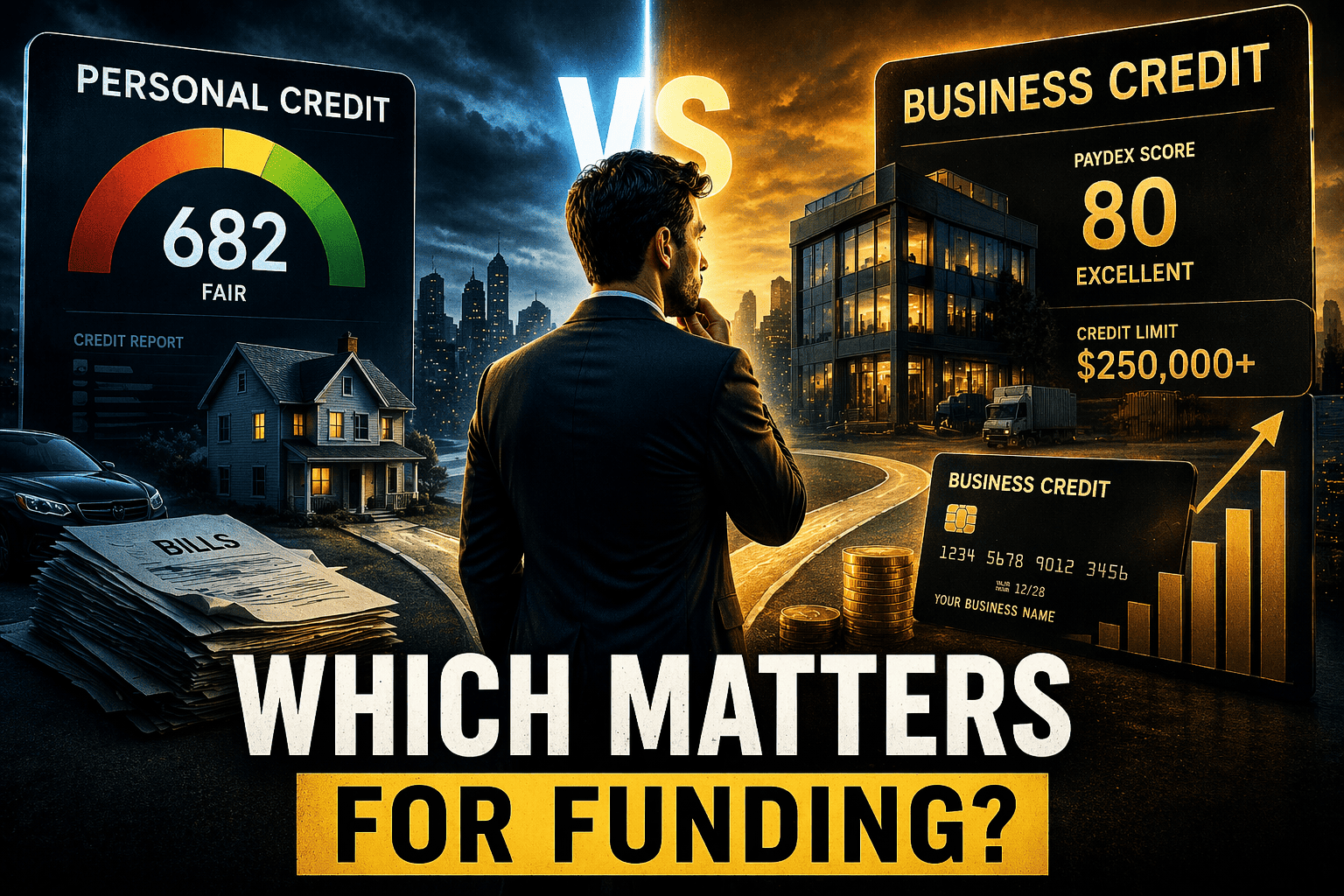
By Ali Badi, Credit Analyst at Score Machine | Last updated: July 3, 2026 | Fact-checked against Federal Reserve, IRS, and Dun & Bradstreet sources.
I review business credit reports for a living, and if there's one question I hear more than any other, it's this: "Does my personal credit even matter for a business loan, or is it all about the business score?" The honest answer is that both matter — just at different times, and in ways most owners don't expect. In this guide, I'll walk you through exactly how the two systems differ, where the real risks hide, and how to build a business credit profile that stands on its own.
The simplest way I explain it: ask yourself who is being evaluated. Is it you, the individual, or your company? Your personal credit is tied to your Social Security Number (SSN) and tells lenders how you handle things like mortgages and car loans. Your business credit is linked to your company's Employer Identification Number (EIN) and measures the financial trustworthiness of the business itself.
Quick Answer: Which credit matters for funding depends on your business's age. If your company is under about three years old, lenders lean almost entirely on your personal FICO score — it's the only reliable track record they have. Once your business has 2–3 years of reported payment history, your business credit scores (D&B PAYDEX, FICO SBSS) increasingly drive approvals, limits, and rates. The strongest position you can be in is having both: a personal score above 680 and a PAYDEX of 80+.
In this guide: The critical divide · Key differences table · How the scoring systems work · Legal protections and liability · How lenders see you · Building business credit step by step · FAQs
The Critical Divide Between Business And Personal Credit
Let me be blunt with you: getting a handle on the difference between business credit and personal credit isn't an accounting chore. It's how you protect your personal assets while giving your company room to grow. When your business builds its own credit profile, you create a financial firewall — and that firewall is what keeps your savings, your home, and your car off the table if the business hits a rough patch.
But I don't want you thinking about this purely as defense. It's also the first real step toward a company that stands on its own feet. A strong business credit profile opens doors to larger loans, better interest rates, and more flexible payment terms with suppliers — without you having to lean on your personal credit history every time. (I've laid out the complete roadmap in our Business Credit Funding Guide if you want the full picture.)
Defining the Two Credit Worlds
Think of personal and business credit as two parallel universes. Each has its own rules, its own reporting agencies, and its own scoring models. When I pull both reports for a client, I'm genuinely looking at two different stories about the same person's finances — and lenders read them through entirely different lenses.
This infographic shows the core distinction at a glance: your personal financial life is tied to your SSN, while your business's financial identity is built around its EIN.
[IMAGE 1: credit-comparison infographic — ⚠️ RE-HOST: download from cdn.outrank.so, upload to your media library, set alt="Side-by-side comparison of business credit and personal credit systems"]
Here's the point I want you to take from it: your business can — and absolutely should — have a financial identity that's completely separate from yours.
That separation is what lets you chase growth opportunities that would otherwise be out of reach if you were limited by your personal score alone. It lays the groundwork for the business to succeed on its own merits.
Key Differences At A Glance

Before we go deeper, here's how the two systems compare side by side. Both involve borrowing and repayment, but how they function is worlds apart.
| Attribute | Personal Credit | Business Credit |
|---|---|---|
| Tied to | Your Social Security Number (SSN) | Your Employer Identification Number (EIN) |
| Score range | 300–850 (FICO, VantageScore) | 0–100 (D&B PAYDEX); 0–300 (FICO SBSS); other scales vary |
| Credit bureaus | Equifax, Experian, TransUnion | Dun & Bradstreet, Experian Business, Equifax Business |
| Biggest scoring factor | Payment history (35%) + credit utilization (30%) | How promptly you pay vendors and suppliers |
| Legal protections | Strong — FCRA guarantees disputes and free annual reports | Minimal — few federal protections apply |
| How long negatives last | Most fall off after ~7 years | Can remain indefinitely |
| Who can see it | Private — only with your permission | Public — anyone can purchase your report |
| Checking your own score | No impact (soft pull) | No impact |
| Mainly used for | Mortgages, auto loans, personal cards — and small business loans when the company is young | Business loans, credit lines, net-30 vendor terms, larger funding |
Look closely at three rows in particular: legal protections, how long negatives last, and who can see it. In my experience, these are the differences that catch owners completely off guard — and they have massive real-world consequences for how you manage your finances.
"The journey to significant business funding begins with a single, non-negotiable step: establishing a credit profile for your company that is entirely independent of your personal finances. This isn't just good practice; it's the bedrock of scalable growth and asset protection."
How Credit Scoring And Reporting Systems Work

If you want to understand the real difference between business credit and personal credit, you have to start where I start every analysis: with how the scores themselves are calculated. These aren't two flavors of the same thing. They operate in completely different universes, with their own scales, agencies, and rules — and that's exactly what shapes the funding and terms your business can get.
You already know your personal credit score, at least roughly. It's a financial picture of you as an individual, painted by the "big three" consumer bureaus: Equifax, Experian, and TransUnion.
[IMAGE 2: business-personal image — ⚠️ RE-HOST: download from cdn.outrank.so, upload to your media library, set alt="How lenders weigh personal and business credit at different business ages"]
Those agencies track your personal habits — your mortgage, car loan, and credit card payments — and run the data through models like FICO and VantageScore to produce that familiar three-digit number.
The Personal Credit Scoring Model
Consider a hypothetical example I use with clients all the time: imagine you're a small business owner ready to expand. Your personal score is stuck around 650 because of some old medical bills. But your business, which has a solid history of paying vendors on time, carries a PAYDEX score of 85. That gap tells you everything about why these systems need to be understood separately.
Personal scores from FICO or VantageScore run from 300-850. Business scores use wildly different scales — the 0-100 PAYDEX, or others running 0-300 or even 101-992. The systems don't even speak the same language. And exactly how high each score needs to be varies by financing type — I break that down, lender by lender, in our guide to the credit score needed for a business loan.
One factor I want you to watch on the personal side is your credit utilization ratio — how much of your available credit you're actually using. High balances on your personal cards can crush your score even if you never miss a payment. I see this trap constantly with entrepreneurs who mix business and personal expenses.
The Business Credit Reporting Landscape
The business credit world has its own gatekeepers: Dun & Bradstreet (D&B), Experian Business, and Equifax Business. These bureaus couldn't care less about your personal mortgage. They're only interested in how your company handles its own obligations.
The D&B PAYDEX score is the one you'll run into most, and it's a perfect example of the different focus. It's built almost entirely on one thing: your company's payment history with vendors and suppliers.
A PAYDEX score ranges from 0 to 100. A score of 80 or higher tells the world your business pays its bills on time — or even early. When a supplier is deciding whether to extend you trade credit, this is the gold standard they check.
Notice what's missing: unlike personal credit, where debt levels are a major red flag, business scores don't fixate on utilization. What they reward is consistency and promptness. That shift in focus changes how you should run your accounts payable — I'll show you how below.
Practical Implications Of Scoring Differences
So what's the real-world takeaway? The two systems reward completely different behaviors. A good personal score comes from carefully managing your debt. A good business score comes from building a documented history of paying suppliers on schedule.
Here's why that matters to your cash flow: a business with a PAYDEX of 85 can often negotiate net-30, net-60, or even net-90 trade terms. You get your inventory today and don't pay for up to 90 days — a massive, interest-free boost to your working capital. You simply cannot get that kind of strategic advantage with personal credit. I've laid out the full playbook in how to build business credit and unlock better funding.
Understanding Your Legal Protections and Liability Risks
Here's something most owners don't realize until it's too late. When you swipe a personal credit card, you're wrapped in a safety net of federal consumer-protection laws. The moment you use credit for your business, you step into a world where most of those protections don't apply. Of all the differences between business and personal credit, this is the one I most need you to understand.
Your personal credit is shielded by the Fair Credit Reporting Act (FCRA) — your armor in the financial world. It gives you the right to dispute inaccurate information, demand its removal after an investigation, and see exactly what's in your file. (The CFPB explains your full rights under the FCRA, including free annual reports and dispute procedures.)
The business credit world? It operates more like the Wild West. There's no equivalent federal safety net, which leaves you with far fewer built-in protections against reporting errors or unfair practices.
Consumer Protections: A Stark Contrast
Let me put the difference in concrete terms. On the personal side, the FCRA guarantees free reports from the three major bureaus and a mandated 30-day window for investigating your disputes. On the business side, just accessing your own company's file from Dun & Bradstreet or Equifax Business often costs money, and the correction process is far less defined.
And the errors stick around. Negative marks on a business report don't automatically fall off after seven years the way they do on your personal file — they can linger indefinitely. That's a serious risk when you consider that the Federal Reserve's Small Business Credit Survey has found roughly 45% of U.S. firms with under $1 million in revenue rely on the owner's personal credit, blurring these protective lines.
My advice: assume nobody is protecting your business credit file but you. Monitor it proactively, dispute errors early, and don't wait for a loan application to discover a problem.
The Personal Guarantee: The Great Equalizer

If I could get every business owner to understand one document before signing it, it would be the personal guarantee (PG). When you sign a PG for a business loan, you're personally promising to repay the debt if your business can't. That one signature pierces the corporate veil that's supposed to protect your personal assets.
Suddenly, the legal separation you built with your LLC or corporation vanishes. If your business defaults, the lender can legally come after your:
- Personal savings account
- Family home
- Cars
- Other personal assets
This is where the theoretical discussion of business vs. personal credit gets painfully real.
A personal guarantee legally transforms a business debt into a personal obligation. It's the bridge that lets business financial distress walk directly into your personal life, putting everything you own at risk.
Real-World Liability Scenarios
Let me make this tangible with a hypothetical example. Meet Sarah, a graphic designer who starts her agency as an LLC. She's built an excellent personal FICO score of 780. To buy new equipment, she takes out a $40,000 business loan — and because her business is new with no credit history of its own, the lender requires a personal guarantee.
A year later, a major client goes bankrupt and Sarah's cash flow dries up. She misses several loan payments. Because of that guarantee, the lender reports the delinquencies to the consumer bureaus.
The fallout is brutal. Her personal FICO drops by over 100 points, wiping out years of discipline. Her business is in trouble, and now her ability to get a mortgage or even a car loan is shot too. I've seen this exact pattern play out, and it's why I tell you: building standalone business credit — free from personal guarantees — is one of the most important defensive moves you can make.
How Lenders See Your Credit Profile

When you walk into a bank or apply online, the lender isn't just looking at a number. They're piecing together a story about risk — and how they weigh business credit vs personal credit changes dramatically depending on whether your business is brand new or has a few years behind it. Many underwriters frame the evaluation as the "five Cs of credit" — character, capacity, capital, collateral, and conditions — and your credit profiles feed directly into the first two.
If your company is young, your personal credit history is the story. With no business track record to go on, lenders fall back on your personal FICO score as the best available predictor of how you'll handle their money.
The downside? Because the risk is tied to you rather than a proven business entity, startups almost always get stuck with higher interest rates and smaller amounts. Every lender draws these lines differently — our review of Capital One business loans shows how a major bank structures its criteria, while revenue-based providers like Everest Business Funding weigh your sales volume more than either credit score. And credit is only one part of the file lenders review — I've compiled the full checklist in mastering the requirements for a commercial loan.
The Shift from Personal to Business Credit Strength
As your business grows and builds its own financial footprint, watch what happens: the lender's attention gradually shifts from your Social Security Number to your company's EIN. This is the milestone I want you working toward.
Once you cross it, lenders start caring a lot more about metrics that prove the business itself is healthy and stable. Here's what they dig into:
- Business Credit Scores: They'll pull reports from Dun & Bradstreet, Experian Business, and Equifax Business to check your PAYDEX or Intelliscore Plus scores.
- Cash Flow and Revenue: Can the business consistently cover its debts? Solid, predictable revenue — and a healthy debt-to-income ratio — is a huge green flag.
- Trade History: A documented record of paying suppliers on time speaks volumes about your reliability.
The data backs this up. According to the Federal Reserve's Small Business Credit Survey, the majority of small employer firms rely on the owner's personal credit score when seeking financing, and low-credit-risk applicants are approved at roughly twice the rate of medium- and high-risk applicants. The pattern is consistent: the younger your business, the more your personal FICO decides the outcome — and the more an established business profile (like a PAYDEX of 80+) pays off later, in the form of higher limits and better pricing.
A Tale of Two Businesses
Let me show you how the business credit vs personal credit difference plays out with two illustrative scenarios.
Business A: The Startup
- The Business: A one-year-old marketing agency.
- The Profile: The owner has a great personal FICO score of 750, but the business has no credit history to speak of.
- The Outcome: The owner gets a $25,000 term loan — with a steep interest rate and a required personal guarantee. Their house and car are on the line if the business fails.
Business B: The Established Player
- The Business: A five-year-old e-commerce brand.
- The Profile: A rock-solid PAYDEX of 85 and two straight years of revenue growth.
- The Outcome: A $250,000 line of credit at a much better rate — no personal guarantee needed.
The comparison couldn't be clearer. Business B got ten times the funding at a lower cost, purely because it invested the time to build a separate, strong business credit profile.
[IMAGE 3: asset-protection image — ⚠️ RE-HOST: download from cdn.outrank.so, upload to your media library, set alt="Steps to build business credit alongside a strong personal credit score"]
This shift doesn't happen on its own. It takes deliberate, disciplined effort to build your company's financial identity from the ground up. But the payoff — more capital, better terms, and your personal assets kept safe — makes it one of the smartest strategic moves you'll ever make.
A Step-By-Step Guide To Building Business Credit

Enough theory — let's talk about what you actually do. Understanding the differences between business credit vs personal credit is one thing; building a powerful business profile is where the rubber meets the road. It doesn't happen by accident, and I'm going to give you the exact sequence I recommend. (If you're starting from absolute zero, my founder's guide on how to build business credit from scratch walks through the first 90 days in detail.)
The whole journey starts with one foundational step: making your business a real, legitimate entity in the eyes of the law. Skip that, and everything else you build sits on sand.
1. Establish Your Business as a Legal Entity
Before you apply for any credit, you need a formal structure — typically a Limited Liability Company (LLC) or a Corporation (S-Corp or C-Corp).
Why do I insist on this first? Because as a sole proprietorship, there's no legal distinction between you and the business. You are the business, and you're personally on the hook for every debt it takes on. Forming an LLC or corporation creates the legal separation that gives your company a foundation to build credit on.
2. Obtain an Employer Identification Number (EIN)
Once you're legally formed, get an Employer Identification Number from the IRS. Think of the EIN as a Social Security Number for your business — a unique nine-digit number that identifies your company for taxes and, crucially for us, for credit reporting.
Without an EIN, the business credit bureaus have no way to track your company's activity. It's non-negotiable. The good news: you can apply for an EIN for free on the IRS website in a few minutes.
3. Open a Dedicated Business Bank Account
Commingling funds — mixing personal and business money — is one of the fastest ways to destroy the legal protection your LLC provides, and I see it wreck otherwise solid applications all the time. The fix is simple: open a dedicated business bank account under your company's legal name and EIN.
This isn't just about making your accountant's life easier. Lenders and bureaus read a separate account as the mark of a professionally run operation. Every dollar of business income goes in; every business expense comes out. No exceptions.
4. Get a D-U-N-S Number
To get on the bureaus' radar, you need to be in their system. Dun & Bradstreet runs on the D-U-N-S Number — a unique nine-digit business identifier. Vendors, suppliers, and lenders will use it to pull your D&B file before extending you a dime of credit.
You can request a D-U-N-S Number from D&B for free. Treat it as your entry ticket — it's the prerequisite for building a PAYDEX score, the metric suppliers check to judge how reliably you pay.
5. Secure Vendor Credit (Net-30 Accounts)
Now you start actually building the file. The easiest on-ramp is opening "trade credit" or Net-30 accounts with vendors — accounts that let you buy now and pay the invoice in 30 days. The trick: choose vendors who report your payment history to the business bureaus.
Start small with known reporters — office supply companies like Uline or Grainger, or packaging suppliers. Make small, necessary purchases and pay them off well before the due date. On-time or early payments are the single most important factor in your business credit score.
6. Apply for a Business Credit Card
Once a few tradelines are reporting, add a business credit card — but check that it reports to the business bureaus, not just your personal ones.
Use it for regular business expenses and — this is the part people skip — pay the balance in full every month. It's a direct, powerful way to add a strong tradeline, prove your company can manage revolving credit, and open the door to much larger funding down the road.
How Score Machine Speeds Up the Path to Funding
Knowing the difference between business and personal credit is one thing. Turning that knowledge into a profile that gets a "yes" from lenders is the real challenge — and it's exactly the problem we built Score Machine to solve.
The platform gives you an AI-driven analysis that shows you what an underwriter sees in both your personal and business files. It goes beyond spitting out a score: it interprets the data, flags specific risks, highlights your strengths, and builds a step-by-step roadmap for improvement — turning the confusing pre-loan scramble into a clear, predictable path to approval. Once your profile is ready, my guide on how to get pre-approved and lock in your funding fast shows you the quickest route from application to cash.
And if you run a funding company, the same credit intelligence works from your side of the desk: instantly pre-qualify applicants against real underwriting criteria, flag the most fundable clients, and automate the deep-dive analysis so your specialists focus on closing deals instead of deciphering reports.
Frequently Asked Questions
Whenever I explain this topic, the same questions come up — so let me answer the business credit vs personal credit questions entrepreneurs ask me most.
Does business credit affect personal credit?
Usually not directly — business accounts tied to your EIN report to business bureaus, not consumer bureaus. The big exception is a personal guarantee: if the business defaults on a guaranteed loan, the lender can pursue you personally and the delinquency can land on your personal credit report. Some business credit card issuers also report activity to consumer bureaus.
Is business credit completely separate from personal credit?
They're separate systems (SSN vs EIN, different bureaus, different scores), but lenders often look at both together — especially through blended scores like the FICO SBSS, which the SBA uses to pre-screen 7(a) loan applicants and which combines your personal credit, business credit, and company financials into a single number.
Can I Use My Personal Credit Card For Business Expenses?
You can, but you absolutely shouldn't. It's one of the easiest ways to get into trouble.
When you mix personal and business spending, you blur the legal line between you and your company. This is called "piercing the corporate veil," and it can leave you personally on the hook for business debts. Beyond that, it complicates bookkeeping and, critically, it does absolutely nothing to build a separate credit profile for your business—the very thing lenders look for.
How Long Does It Take To Establish Business Credit?
You can start the clock on building business credit the moment your company is officially formed. Once you have an EIN and open a few vendor accounts that report to the credit bureaus, your payment history can show up on your report in as little as 30-90 days.
However, building a strong, fundable profile that gets a lender's attention usually takes about 6-12 months of consistent, on-time payments across several different accounts.
Does Checking My Own Business Credit Score Hurt It?
Not at all. Checking your own business credit report is a "soft inquiry," which means it has zero impact on your score. That's different from a hard inquiry, which happens when a lender pulls your credit for an actual application and can temporarily shave a few points off.
In fact, it's a smart habit to get into. Regularly monitoring your reports from major bureaus like Dun & Bradstreet or Experian Business helps you spot errors quickly and see how your efforts to build credit are paying off.
Disclaimer: This article is for informational purposes only and does not constitute financial, legal, or lending advice. Credit reporting practices and lender requirements vary and change over time — always confirm current requirements directly with your lender before applying.
Understanding the full picture of business credit vs personal credit puts you in control of your funding options. Score Machine gives you the clarity to see your credit profile exactly as a lender does — so you know what they'll say before you ever apply.
See what it takes to get fundable at https://thescoremachine.com.
About the author (REPLACE current author box text)
Ali Badi — Credit Analyst at Score Machine Ali Badi is a Credit Analyst at Score Machine, where he reviews business credit reports and helps business owners and funding companies assess funding readiness. He writes about personal and business credit, SBA loan requirements, and credit repair strategy.