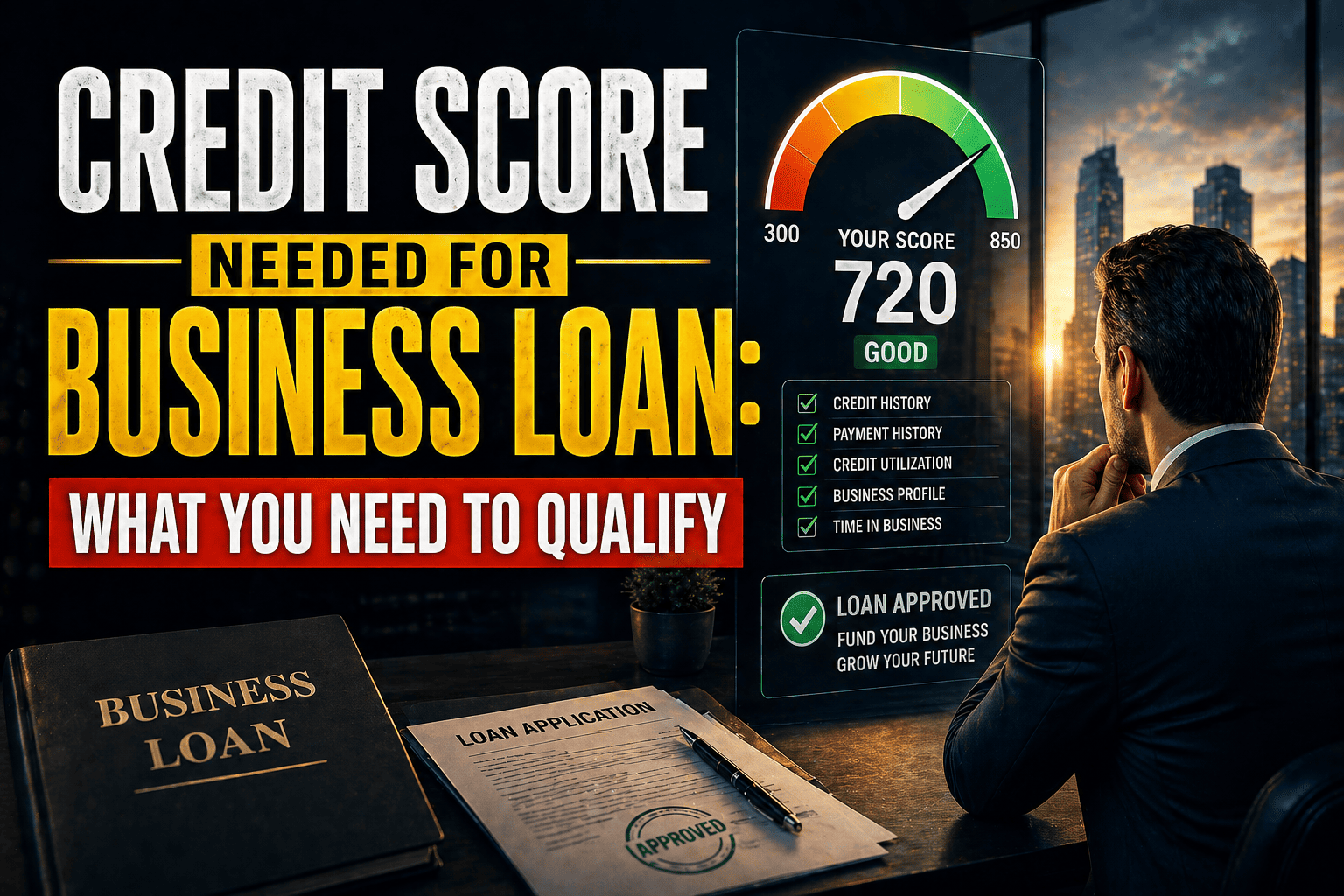
By Ali Badi, Credit Analyst at Score Machine | Last updated: July 3, 2026 | Fact-checked against SBA and Federal Reserve sources.
Learn what credit score you need for a business loan, including SBA, bank, and online lenders. Understand personal vs business credit, SBSS scores, and how to improve funding readiness to qualify faster and secure better loan terms.
So, you're wondering what the credit score needed for a business loan actually is. While there's no single magic number, most lenders want to see a personal FICO score of at least 650. For the most competitive options, like traditional bank loans or SBA-backed financing, you'll likely need a score of 680 or higher — for reference, Bank of America generally looks for a 700 personal score, while Wells Fargo's benchmark sits around 680.
Quick Answer: The credit score needed for a business loan is typically a personal FICO of 650+, with banks and SBA lenders requiring 680+ (plus a FICO SBSS business score of 155+), online lenders accepting 600–620, and revenue-based options like merchant cash advances approving scores as low as 500. This guide is for business owners at every credit level — including those starting below 600 — and covers the exact minimums by loan type, what lenders check beyond your score, and how to raise both scores before you apply.
What Credit Score Do You Really Need for a Business Loan?
Short answer: 680+ for banks and SBA loans, 600–650 for online lenders, and 500–580 for revenue-based financing like MCAs and invoice factoring. The full picture depends on where you're applying and what kind of financing you're after.
Figuring out the minimum credit score for a business loan can feel like trying to hit a moving target. The reality is, the "right" score changes depending on where you're applying and what kind of financing you're after.
Think of it like this: applying for a small, short-term loan from an online lender is like interviewing for an entry-level job—the requirements are more flexible. Applying for a large, long-term loan from a major bank is like going for a senior executive role; the expectations are much, much higher.
[IMAGE: credit-score-needed-for-business-loan-credit-analysis.jpg — keep as is]
No matter where you apply, lenders will zoom in on two key numbers: your personal FICO score and your business credit score. For new businesses and small operations, your personal credit history often carries the most weight. It's the most reliable crystal ball they have to predict how you'll handle your business's financial obligations.
The Two Scores That Matter Most
Your loan application is really a story told in two parts. Lenders look at both your personal financial habits and your company's payment history to get a full picture of the risk involved.
- Your Personal FICO Score: This is the one you're probably familiar with, ranging from 300 to 850. It's a snapshot of how you manage your own debts, from credit cards to car loans. A strong personal score sends a clear signal: you're a responsible borrower.
- Your Business Credit Score: This score reflects your company's financial health and comes from agencies like Dun & Bradstreet (which issues a PAYDEX score) or FICO, which has its own Small Business Scoring Service (SBSS). The SBSS score, on a scale of 0 to 300, is a big deal because it's a key part of the pre-screening process for SBA loans. To get scored by Dun & Bradstreet at all, your business first needs a free DUNS number — think of it as your company's credit ID.
Lenders don't just look at these scores in isolation. They see them as two sides of the same coin, telling a complete story about your financial character. A great personal score can open doors, and a solid business score proves your company can stand on its own two feet.
This is why understanding the lender's perspective is so important. You don't need a perfect 850, but you do need to know where you stand. The credit score needed for a business loan isn't one number—it's a spectrum. Online lenders might be okay with a personal score around 600, but for SBA loans, the SBA's pre-screen floor is an SBSS score of 140 — and most lenders prefer to see 155 or higher.
To make this a bit clearer, here's a quick breakdown of what you can generally expect.
Typical Credit Score Ranges for Business Loans
This table shows the minimum credit score for a business loan that lenders often look for across different types of financing.
| Loan Type | Typical Minimum Personal FICO Score | Typical Minimum Business Score (e.g., FICO SBSS) | Lender Type |
|---|---|---|---|
| SBA 7(a) Loans | 680+ | 140 floor; 155+ preferred | Banks, Credit Unions |
| SBA 504 Loans | 680+ | 140 floor; 155+ preferred | Certified Development Companies, Banks |
| SBA Microloans | 620–640+ | Flexible | Nonprofit Intermediary Lenders |
| Traditional Bank Loans | 680+ (Bank of America: 700; Wells Fargo: 680) | Good standing required | Major Banks, Community Banks |
| Online Term Loans | 620+ | Varies; sometimes not required | Online Lenders |
| Business Line of Credit | 650+ | Varies; established history helps | Banks, Online Lenders |
| Equipment Financing | 620+ | Not always required | Specialized Lenders, Banks |
| Invoice Factoring | 580+ | Focus is on customer credit | Factoring Companies |
| Merchant Cash Advance | 500–550+ | Revenue-based, not score-based | MCA Providers |
Keep in mind, these are just guidelines. A lender might approve an application with a lower score if other factors, like strong revenue or years in business, are particularly compelling.
How to Check Your Personal and Business Credit Scores
Before you apply anywhere, know exactly what lenders will see:
- Personal credit: Pull your free reports from Experian, Equifax, and TransUnion at AnnualCreditReport.com — the only source authorized by federal law. If your file is thin, the Consumer Financial Protection Bureau (CFPB) publishes free guides on building credit from scratch.
- Business credit: Request your reports from Dun & Bradstreet, Experian Business, and Equifax Business. You'll need a DUNS number for D&B's PAYDEX score.
- Watch for inquiry types: Pre-qualifying with most lenders uses a soft credit pull, which never touches your score. A hard inquiry only happens when you formally accept an offer — and it may temporarily trim a few points.
Why Lenders Look at Both Personal and Business Credit
Short answer: because your personal credit predicts how you'll manage the company's debt — especially when the business is too new to have its own track record.
Ever wondered why your personal credit card habits could affect your business loan application? It's a common question, especially for new entrepreneurs. Lenders, however, see a direct line between the two, and they view your personal credit history as a vital clue to your financial character. (For a full side-by-side breakdown, see our guide on business credit vs personal credit — which matters for funding.)
Think of your personal credit score as your financial resume. It tells a detailed story of how you've handled debt in the past. Have you consistently paid bills on time? Kept your credit card balances in check? To a lender, this track record is one of the clearest predictors of how you'll manage your company's finances. A strong personal score signals discipline and lowers their perceived risk.
This is especially true for businesses without much of a track record. When a company is new, it hasn't had time to build its own financial resume. In these situations — including most startup business loans — lenders rely heavily on the owner's personal credit history as a stand-in for the business's potential. That's also why the majority of small business loans come with a personal guarantee: you agree to repay the debt personally if the business can't.
The Blended Picture of Risk
As your business grows and starts paying its own bills—to suppliers, landlords, and on any credit lines—it begins to build its own financial resume. This is its business credit score. This is also where the evaluation gets more nuanced. Lenders don't just pick one score; they often combine them to get a complete picture of your fundability.
One of the most common tools they use is the FICO Small Business Scoring Service (SBSS) score. This score, which runs from 0 to 300, is a hybrid model that pulls data from a few key sources:
- Your personal credit report: Your payment history, how much credit you're using, and other personal financial habits.
- Your business credit report: How your company has managed its own debts and trade lines.
- Your business financials: It can also factor in details like your annual revenue and cash flow.
By blending these data points, the FICO SBSS score gives lenders a single, powerful number to quickly assess the overall risk of lending to your company. It's a 360-degree view that recognizes the tight link between the owner's financial habits and the business's health.
How One Score Can Influence the Other
The relationship between your personal and business credit is a two-way street. This back-and-forth can either make or break your loan application and is a huge factor in determining the credit score you need to qualify for a business loan.
A strong personal credit history can be a massive advantage, particularly for a young business. If your company is only a year or two old, an excellent personal FICO score (740 or above) can seriously improve your chances of getting a "yes." It tells the lender that you, the person driving the business, are a reliable borrower.
On the flip side, an established business with years of solid payment history and healthy revenue can sometimes help make up for a less-than-perfect personal score. If your business credit report shows you've consistently paid vendors and other lenders on time, it proves the company is a stable entity in its own right. This might make a lender more willing to look past some older bumps on your personal credit file.
At the end of the day, lenders are looking for a consistent story of financial responsibility. Actively managing both your personal and business credit profiles isn't just a good habit—it's a critical strategy for any entrepreneur who's serious about getting funding and growing their company. (Our Business Credit Funding Guide walks through this step by step.)
Breaking Down Score Requirements by Loan Type
Think of applying for a business loan like planning a trip. A small, short-term loan is like a quick domestic getaway with flexible rules. A large, government-backed SBA loan? That's more like an international journey with strict customs checks. Each funding option has its own set of expectations, and matching your credit profile to the right one is the first step toward getting approved.
Not all business loans are built the same, and their credit score benchmarks really just reflect how much risk a lender is comfortable taking on. Higher-risk products, like a merchant cash advance, are usually more forgiving on credit but make up for it with higher costs. On the other hand, lower-risk, government-guaranteed loans demand a much stronger credit profile but reward you with the best terms.
[IMAGE: credit-score-needed-for-business-loan-borrower-profiles.jpg — keep as is]
As you can see, while your personal and business credit scores matter on their own, lenders get the most complete—and reassuring—picture when they see a consistent pattern of financial responsibility across both.
SBA and Traditional Bank Loans: The Gold Standard
When you're hunting for the best possible terms, SBA loans and traditional bank loans are the top prize. These are the loans that typically come with the lowest interest rates and the longest, most manageable repayment periods, which is why they're so popular with established businesses. But, this lower risk for the lender means they have much higher standards for you.
A strong credit history isn't just a suggestion here; it's a hard requirement. Most banks and SBA-approved lenders will want to see a personal FICO score of 680 or higher — the credit score needed for an SBA loan is among the highest of any financing type. Exact requirements vary from bank to bank; our review of Capital One business loans is a good real-world example of how a major bank structures its criteria. The Small Business Administration (SBA) even has its own special screening tool it uses to vet applicants for its flagship 7(a) loan program. Its 504 loan program (for real estate and major equipment) holds similar standards, while SBA Microloans — smaller loans up to $50,000 issued through nonprofit lenders — are more forgiving, often approving scores in the 620–640 range.
In the U.S., the SBA's pre-screening floor for 7(a) loans is a FICO SBSS score of 140 out of 300 — but in practice, most participating lenders set their own bar at 155 or higher. Falling below the floor means an automatic route to manual review or denial, which is why approval odds drop sharply under 140. The Federal Reserve's Small Business Credit Survey consistently finds that low-credit-risk applicants are roughly twice as likely to be approved for financing as medium- and high-risk applicants.
This strict screening is in place to make sure that government-guaranteed funds go to businesses with a solid track record, protecting both the lender and the taxpayer.
Online Lenders: The Accessible Alternative
The fintech boom has opened up a whole new world of funding, especially for businesses that might not clear the high hurdles set by traditional banks. These online lenders use technology to speed up the application process and can often get cash in your hands much faster. That flexibility also applies to their credit requirements.
For many online term loans or lines of credit, the bar is a bit lower. Here's a general idea of what they're looking for:
- Minimum Personal FICO Score: Often starts in the 600–620 range.
- Time in Business: They usually want to see at least one year of operation.
- Annual Revenue: Minimums can fall anywhere from $50,000 to $100,000.
Of course, this accessibility comes with a trade-off. Interest rates from online lenders are almost always higher than what you'd get from a bank—that's how they balance out the extra risk they're taking on. Still, they provide a crucial service for businesses that need capital fast or are still working on building a stellar credit history. If speed is your priority, our guide on how to get pre-approved and lock in your funding fast walks through the quickest path from application to cash.
Can You Get a Business Loan With Bad Credit?
Yes — but your options narrow and your costs rise. If your personal score sits below 600, here's the realistic landscape for bad credit business loans:
- 550–600: Short-term online loans, equipment financing (the equipment itself acts as collateral), and invoice financing are your most likely approvals. Some online lenders work with scores as low as 570.
- 500–550: Merchant cash advances and invoice factoring remain on the table because they're underwritten on your sales volume or your customers' creditworthiness — not your score.
- Below 500: Focus first on credit repair and secured options. A few months of on-time payments and lower credit utilization can move you into a qualifying range faster than you'd think — our founder's guide on how to build business credit from scratch breaks down realistic first steps.
The trade-off is always price: expect higher factor rates, shorter repayment windows, and possible collateral or personal guarantee requirements. Treat these as bridge financing while you build toward bank-grade credit.
Merchant Cash Advances and Invoice Factoring
What if your credit history makes it tough to qualify for a traditional loan? For businesses in that boat, options like merchant cash advances (MCAs) and invoice factoring offer a different route to cash. These funding types care less about your credit score and more about your sales volume or the reliability of your customers.
With an MCA, a provider gives you cash upfront in exchange for a slice of your future credit and debit card sales. Since your repayment is tied directly to your daily revenue, your past credit mistakes matter a lot less. (Curious how a real provider operates? See our review of Everest Business Funding.) Invoice factoring works similarly; you sell your unpaid invoices to a company at a discount to get cash immediately. The factoring company is betting on your customers' ability to pay, not yours.
While these can be a lifesaver in a pinch, they are typically the most expensive ways to get funding. It's best to think of them as a short-term fix to plug a cash-flow gap, not a long-term financing strategy.
What Lenders See Beyond Your Credit Score
A great credit score is a fantastic start, but it's just one chapter in your business's financial story. Lenders, of course, read the whole book. While the credit score needed for a business loan is a critical first hurdle, underwriters dig much deeper to get a true feel for your company's health before they'll sign off on funding. (For the complete document-by-document checklist, see our guide to mastering the requirements for a commercial loan.)
Think of it like a full physical for your business. Your credit score is the blood pressure reading—it's a vital sign, for sure, but it doesn't tell the whole story. Lenders want to see the full chart, from your company's daily habits to its long-term stability. This complete picture is what helps them really understand the risk involved.
The Financial Vitals Lenders Examine
Beyond the score, underwriters get into the nitty-gritty performance metrics that show you know how to manage money and turn a profit. These numbers offer tangible proof that your business can take on new debt and keep growing. In fact, a strong showing in these areas can sometimes make up for a credit score that's just okay.
Here are the key indicators that paint that picture for lenders:
- Annual Revenue: This is a straightforward look at your sales activity. Lenders need to see healthy and, ideally, growing revenue that can comfortably cover new loan payments.
- Cash Flow: This might be the single most important factor after your credit score. Positive cash flow means more money is coming in than going out, proving you have the liquid cash to handle monthly installments without breaking a sweat.
- Time in Business: A longer track record is a sign of stability. Most traditional lenders want to see at least two years under your belt, which shows you've made it past the notoriously tough startup phase.
- Debt-to-Income Ratio (DTI): For your business, this is all about existing debts versus your income. A high DTI can be a major red flag, suggesting your company might be stretched too thin to handle another payment.
- Personal Guarantee: Most small business loans require one. Be prepared for the lender to ask you (and any co-owners) to personally back the debt.
A business with a mediocre credit score but rock-solid, consistent cash flow is often a better bet than one with a great score but wildly unpredictable income. Lenders value predictability above almost everything else.
Why Your Industry and Collateral Matter
Your business doesn't exist in a bubble, and lenders are keenly aware of that. They also look at external factors, like the risk profile of your specific industry. A company in a stable, established field like healthcare might get a more favorable look than one in a high-risk or seasonal industry, like a trendy new restaurant concept.
Collateral also changes the game completely. If you can put up valuable assets—like real estate, equipment, or even inventory—to secure the loan, you instantly lower the lender's risk. Having strong collateral can make you a much more attractive borrower, often unlocking better terms and higher loan amounts. It gives the lender a safety net in a worst-case scenario.
Putting it all together, the impact is huge. Banks typically look for a personal FICO score of 680+ for their conventional term loans, and clearing that line doesn't just improve your odds of a "yes" — it changes the entire offer: lower rates, longer terms, and higher amounts. Per the Federal Reserve's Small Business Credit Survey, low-credit-risk borrowers are approved at roughly double the rate of riskier applicants at banks and finance companies. At the end of the day, showing a complete picture of financial strength is what gets you funded.
How to Improve Your Business Funding Readiness
Knowing where your credit scores stand is one thing; actually reaching the credit score needed for a small business loan is another. Building a strong credit profile doesn't happen overnight. It's a deliberate process of proving you're financially responsible, and it's the key to unlocking the capital you need.
Think of it like getting in shape for a marathon. You wouldn't just roll out of bed and expect to run 26.2 miles. You'd follow a training plan to build strength and endurance over time. The same logic applies here—each step you take builds positive financial momentum and gets you closer to that funding finish line.
[IMAGE: credit-score-needed-for-business-loan-funding-roadmap.jpg — keep as is]
Strengthen Your Personal Credit Foundation
Before you can build a credible business profile, your personal finances have to be rock-solid. Lenders look at your personal FICO score as a window into your financial habits, so this is where the real work begins.
Focus on these three areas to get the biggest bang for your buck:
- Pay Every Single Bill on Time: This is non-negotiable. Your payment history makes up a massive 35% of your personal credit score. Just one late payment can send your score tumbling, so put everything on autopay to make sure nothing ever slips through the cracks.
- Lower Your Credit Utilization: Lenders get antsy when they see maxed-out credit cards. The rule of thumb is to keep your balances below 30% of your total available credit. If you have a $10,000 limit across all your cards, your total balance shouldn't creep past $3,000.
- Scrub Your Credit Reports for Errors: You'd be surprised how often mistakes pop up on credit reports, and those errors can unfairly drag down your score. Get your free reports from the big three bureaus—Experian, Equifax, and TransUnion—via AnnualCreditReport.com and immediately dispute anything that looks off. The CFPB publishes free templates for dispute letters if you need a starting point.
Build a Robust Business Credit Profile
With your personal credit in good shape, it's time to give your business its own financial identity. The idea is to create a track record that proves your company can handle its own debts, separate from you.
Your goal is to build a clear, consistent history of on-time payments that business credit bureaus can see and score. This doesn't happen by accident; it's about taking intentional steps to show lenders your business is a safe bet.
A great way to start is by opening accounts that report to bureaus like Dun & Bradstreet. (We cover the full playbook in how to build business credit and unlock better funding.) Here's how:
- Register for a DUNS Number: It's free from Dun & Bradstreet and is the prerequisite for building a PAYDEX score.
- Establish Trade Lines with Vendors: Find suppliers who will report your payment history to the bureaus. These "trade lines" are a fantastic way to build business credit without taking on a traditional loan.
- Get a Business Credit Card: Use it for everyday business expenses, but—and this is key—pay the balance in full every month. It's a direct and powerful way to show you can manage credit responsibly.
- Secure a Small Business Loan or Line of Credit: Even a small, manageable loan can work wonders for your credit history, as long as you make every single payment on time.
Building a strong business credit profile has a real-world payoff. Online lenders might approve borrowers with scores in the 600–650 range, but that access comes at a steep price — APRs on short-term online loans routinely run several times higher than the single-digit rates banks reserve for borrowers with scores above 720. Over the life of a loan, that spread can amount to tens of thousands of dollars.
That's the real takeaway: actively improving the credit score needed for a business loan isn't just an administrative task; it's a direct investment in your company's bottom line.
Turning a "No" Into a "Not Yet"
(This short section replaces both "Boosting Loan Approvals with Credit Intelligence" and "How Funding Companies Can Increase Funding Volume with Score Machine" — delete both originals. The full B2B pitch should live on a dedicated page this section links to.)
The traditional funding process is black and white: an applicant either has the credit score needed for a business loan, or they don't. But a denial doesn't have to be a dead end. Credit intelligence tools like Score Machine analyze a credit report in seconds and turn it into a specific, data-driven repair plan — which errors to dispute, which balances to pay down, and which trade lines to open — so a borrower who's almost fundable knows exactly how to get there.
If you run a funding company, the same analysis works from the other side of the desk: fast-track qualified applicants, and convert denials into a pipeline of future approvals. See how funding companies use Score Machine →
FAQs: Credit Score Needed for a Business Loan
What is the minimum credit score for a business loan?
Most lenders want a personal FICO score of at least 600–650. Traditional banks and SBA lenders typically require 680 or higher, while some online lenders, factoring companies, and MCA providers work with scores in the 500–580 range.
What credit score do you need for an SBA loan?
Most SBA 7(a) lenders look for a personal FICO score of 680+ and a FICO SBSS score of at least 155 (the SBA's pre-screening floor is 140 out of 300). SBA Microloans are more flexible, often approving borrowers in the 620–640 range.
Can I get a business loan with a 500 credit score?
It's difficult but possible. Merchant cash advances, invoice factoring, and some secured financing are underwritten on your revenue or your customers' credit rather than your score — just expect significantly higher costs and shorter terms.
Do business loans check personal or business credit?
Usually both. For newer companies, your personal FICO score carries the most weight. Established businesses are also evaluated on business scores like Dun & Bradstreet's PAYDEX and the FICO SBSS, which blends personal credit, business credit, and company financials.
Does applying for a business loan hurt my credit score?
Pre-qualification typically uses a soft inquiry, which has no impact on your score. Formally accepting an offer usually triggers a hard inquiry, which can lower your score by a few points temporarily.
How can I improve my credit score before applying for a business loan?
Pay every bill on time (payment history is 35% of your FICO score), keep credit utilization under 30%, dispute report errors with Experian, Equifax, and TransUnion, get a DUNS number, and open vendor trade lines that report to the business bureaus.
Disclaimer: This article is for informational purposes only and does not constitute financial, legal, or lending advice. Credit score requirements vary by lender and change over time — always confirm current requirements directly with your lender before applying.
Ready to turn applicant data into your most powerful asset? Score Machine provides the AI-powered credit intelligence to analyze reports in seconds, identify fundable clients, and create actionable repair plans that build a loyal, future-ready pipeline. See how it works at https://thescoremachine.com.
AUTHOR BOX (filled)
About the Author Ali Badi is a Credit Analyst at Score Machine, where he reviews business credit reports and helps business owners and funding companies assess funding readiness. He writes about personal and business credit, SBA loan requirements, and credit repair strategy.
When Ali's LinkedIn profile is ready, add "Connect on LinkedIn: <url>" to the box and the matching sameAs property to the Person schema. If he has specific credentials (years of experience, certifications, past lending roles), add one sentence about them — the bio currently sticks to verifiable role-based facts only.