By Ali Badi | Reviewed for accuracy July 2026 | Rates and fees verified as of July 13, 2026 — always confirm current terms on the issuer's website before applying.
Advertiser disclosure: Score Machine may receive compensation if you apply for products through links on this page. This does not affect our rankings, which are based on fees, deposit requirements, credit bureau reporting, and graduation paths.
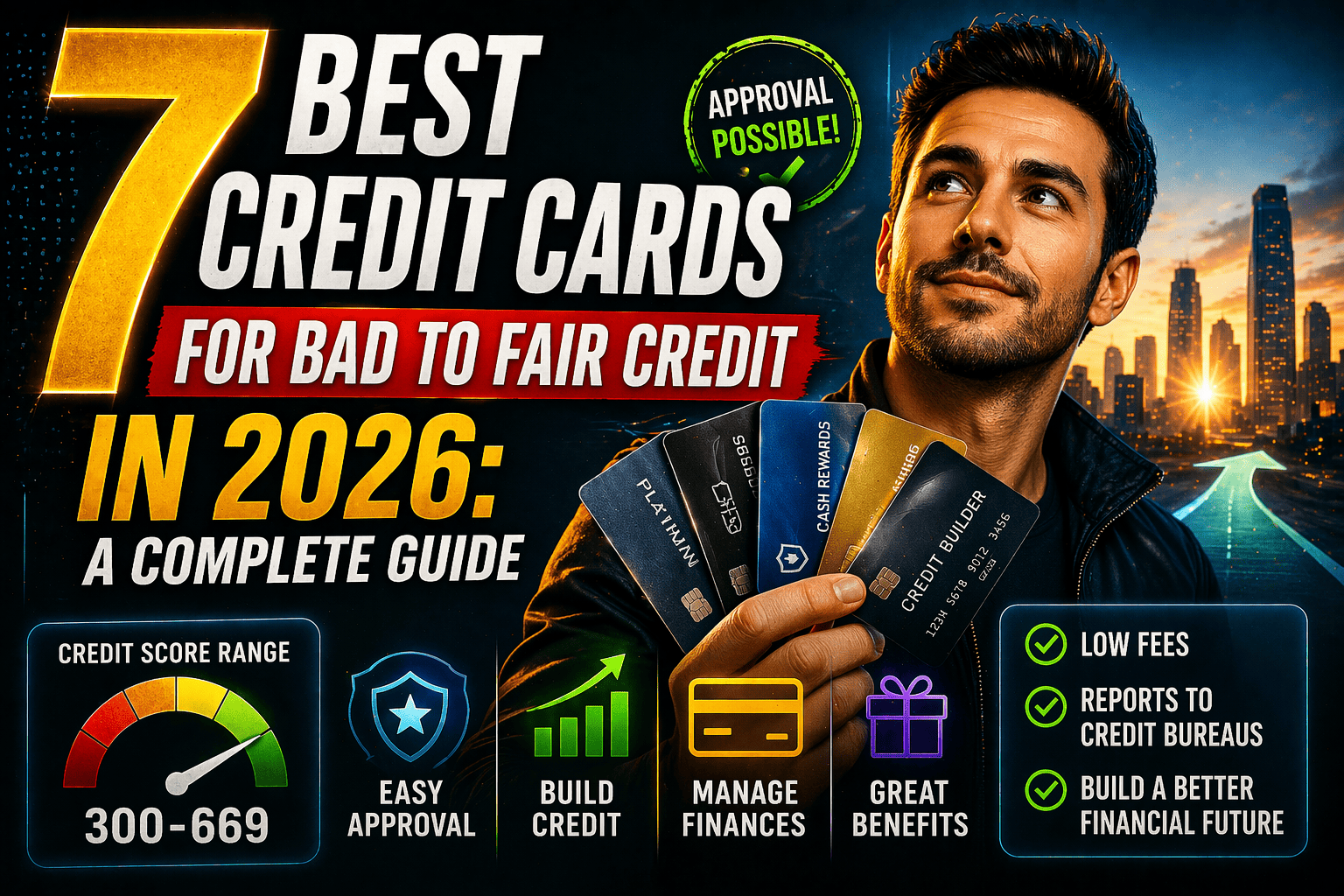
A bad or fair credit score doesn't lock you out of credit cards — it just narrows the field. If your FICO score falls between 300 and 579, lenders consider it bad (poor) credit. A score of 580 to 669 counts as fair credit. In both ranges, the right card can rebuild your history; the wrong one can bury you in fees.
This guide compares the 7 best credit cards for bad to fair credit in 2026 — actual cards, with real deposit requirements, annual fees, and upgrade paths. Every card here reports to all three major credit bureaus (Experian, Equifax, and TransUnion), which is the single non-negotiable feature for credit building: if a card doesn't report your on-time payments, it can't raise your score. And once you cross the 670 mark, an entirely new tier of products opens up — bookmark our complete guide to the best credit cards for good credit for when you get there.
Our top picks at a glance:
- Best overall: Discover it® Secured Credit Card
- Best low deposit: Capital One Platinum Secured
- Best secured card with rewards: Capital One Quicksilver Secured
- Best unsecured card for fair credit: Capital One QuicksilverOne
- Best unsecured card for bad credit: AvantCard Credit Card
- Best with no credit check: OpenSky® Secured Visa®
- Best no-fee, no-interest option: Chime Credit Builder Visa
Comparison Table: Best Credit Cards for Bad to Fair Credit (July 2026)
| Card | Type | Annual Fee | Min. Deposit | Credit Check | Reports to 3 Bureaus | Rewards | Graduation Path |
|---|---|---|---|---|---|---|---|
| Discover it® Secured | Secured | $0 | $200 | Yes | ✅ | 2% gas & restaurants (up to $1,000/qtr), 1% everything else + first-year Cashback Match | Automatic reviews from month 7 |
| Capital One Platinum Secured | Secured | $0 | $49, $99, or $200 for a $200 line | Yes | ✅ | None | Automatic reviews; deposit can be returned |
| Capital One Quicksilver Secured | Secured | $0 | $200 | Yes | ✅ | 1.5% on all purchases; 5% on hotels/rental cars via Capital One Travel | Automatic line reviews in as little as 6 months |
| Capital One QuicksilverOne | Unsecured (fair credit) | $39 | None | Yes | ✅ | 1.5% on all purchases | Considered for higher line in ~6 months |
| AvantCard | Unsecured (bad/limited credit) | $0 | None | Yes (soft-pull prequal available) | ✅ | Rewards auto-redeemed as statement credit | Credit line reviews over time |
| OpenSky® Secured Visa® | Secured | Yes (see issuer) | ~$200–$300 | No credit check | ✅ | None | No guaranteed path |
| Chime Credit Builder Visa | Secured (via Chime account) | $0 | Flexible (funds you move in) | No credit check | ✅ | None | N/A — no interest charged |
APRs on cards for bad and fair credit are typically high (often 25%–36% variable). Exact rates change frequently — check the issuer's current terms. The safest strategy at any APR: pay your statement balance in full every month.
1. Discover it® Secured Credit Card — Best Overall
The Discover it® Secured is the rare rebuilding card that behaves like a rewards card. There's no annual fee, and you earn 2% cash back at gas stations and restaurants on up to $1,000 in combined purchases each quarter, plus 1% on everything else. At the end of your first year, Discover matches all the cash back you earned — effectively doubling it.
How it works: You provide a refundable security deposit starting at $200, which becomes your credit limit. You'll need a bank account to fund it. Discover reports to all three bureaus and gives you free access to your FICO® Score so you can watch your progress.
The graduation path is the real selling point. Starting at month seven, Discover automatically reviews your account monthly. Use the card responsibly and you can graduate to an unsecured card and get your full deposit back — no new application, no new hard inquiry.
- Best for: Anyone with bad credit who can afford a $200 deposit and wants rewards while rebuilding
- Pros: No annual fee, cash back + first-year match, clear automatic graduation, free FICO score
- Cons: High variable APR; requires a bank account and a credit check
- Rates verified: July 2026 — confirm at discover.com
2. Capital One Platinum Secured — Best Low Deposit
Most secured cards demand a deposit equal to your credit limit. The Capital One Platinum Secured breaks that rule: depending on your creditworthiness, you may qualify for a $200 credit line with a deposit of just $49 or $99 (or the standard $200).
There's no annual fee, and Capital One automatically considers you for a higher credit line — and eventually the return of your deposit as a statement credit — with responsible use. Cardholders also get free credit monitoring through CreditWise, which tracks your TransUnion VantageScore 3.0.
Use the pre-approval tool first. Capital One's "See If You're Pre-Approved" check uses a soft inquiry only, so you can gauge your odds without touching your score — critical when every hard inquiry counts.
- Best for: Rebuilders who can't tie up $200 in a deposit
- Pros: Deposit as low as $49, no annual fee, soft-pull pre-approval, automatic upgrade reviews
- Cons: No rewards; high variable APR
- Rates verified: July 2026 — confirm at capitalone.com
3. Capital One Quicksilver Secured — Best Secured Card With Rewards
If you can fund the full $200 refundable deposit, the Quicksilver Secured upgrades the Platinum Secured formula with flat-rate rewards: unlimited 1.5% cash back on every purchase, plus 5% back on hotels and rental cars booked through Capital One Travel — earning rates almost unheard of for a bad-credit card.
Like its sibling, it has a $0 annual fee, $0 fraud liability, automatic consideration for a higher credit line in as little as six months, and a path to earning your deposit back through on-time payments.
- Best for: Rebuilders with bad credit (FICO ~629 or lower) who want the strongest rewards available at this tier
- Pros: 1.5% cash back everywhere, no annual fee, deposit-back pathway, CreditWise included
- Cons: Full $200 deposit required; high variable APR
- Rates verified: July 2026 — confirm at capitalone.com
4. Capital One QuicksilverOne — Best Unsecured Card for Fair Credit
Once your score reaches the fair range (580–669), you can skip the deposit entirely. The QuicksilverOne is available to limited-to-fair credit profiles and still pays an elevated unlimited 1.5% cash back on all purchases — unusual for this credit tier.
The trade-off is a $39 annual fee. If you spend more than $2,600 a year on the card, the cash back covers the fee; below that, a no-fee secured card may be cheaper. Capital One automatically considers you for a higher credit line in as little as six months.
- Best for: Fair-credit applicants who want rewards without a security deposit
- Pros: 1.5% cash back, no deposit, soft-pull pre-approval, fast credit line reviews
- Cons: $39 annual fee; high variable APR
- Rates verified: July 2026 — confirm at capitalone.com
5. AvantCard Credit Card — Best Unsecured Card for Bad Credit
Unsecured cards for genuinely bad credit are usually a minefield of setup fees and monthly "maintenance" charges. The AvantCard (issued by WebBank) is the exception: a $0-annual-fee unsecured card that can look beyond your credit score when evaluating your application, reports to all three major bureaus, and even earns rewards that are automatically redeemed as a statement credit each billing cycle.
- Best for: Bad-credit applicants who don't have cash for a deposit and want to avoid fee-heavy subprime cards
- Pros: No annual fee, no deposit, alternative underwriting, automatic rewards redemption
- Cons: Approval isn't guaranteed; credit limits start low; high variable APR
- Rates verified: July 2026 — confirm at avant.com
Considering other no-deposit cards for bad credit? The Milestone Mastercard is another option marketed to this tier, but its fees run higher — read our full Milestone credit card review covering fees, approval odds, and credit-building value before you apply.
6. OpenSky® Secured Visa® — Best With No Credit Check
If you've been denied elsewhere — recent bankruptcy, charge-offs, or a very thin file — the OpenSky Secured Visa removes the biggest barrier: there is no credit check at all. Approval depends on identity, income, and age requirements plus your refundable security deposit, which sets your credit limit.
OpenSky reports to all three bureaus, and the results are measurable: according to OpenSky, two out of three cardholders see an average 47-point score increase after six months of use. The company says more than 2 million cardholders have used its cards to build credit.
The catches: there's an annual fee, no rewards, and no guaranteed graduation to an unsecured card. Treat OpenSky as a 12–18 month launchpad — build the payment history, then move up to a better card and close the loop.
- Best for: Applicants who can't pass a credit check anywhere else
- Pros: No credit check, near-certain approval with a deposit, reports to all 3 bureaus, deposit layaway option
- Cons: Annual fee, no rewards, no guaranteed upgrade path
- Rates verified: July 2026 — confirm at openskycc.com
7. Chime Credit Builder Visa — Best No-Fee, No-Interest Option
The Chime Credit Builder works differently from a traditional secured card. You move money from your Chime checking account onto the card, and that amount becomes your spending limit. There's no annual fee, no interest charges, and no credit check — and Chime reports your payment activity to all three bureaus.
Because you can only spend money you've already set aside, it's nearly impossible to fall into debt with this card. The limitation is the same as the strength: there's no revolving credit line, no rewards, and you need a Chime checking account with qualifying direct deposits to open it.
- Best for: People who want zero-risk credit building with no fees or interest
- Pros: $0 fees, 0% interest by design, no credit check, flexible "deposit"
- Cons: Requires a Chime account with direct deposit; no rewards; no traditional credit limit growth
- Rates verified: July 2026 — confirm at chime.com
Where to Compare Offers and Check Your Approval Odds
Before you apply anywhere, use these free tools to prequalify with a soft inquiry — it protects your score from unnecessary hard pulls:
- Capital One pre-approval and Discover's prequalification tool — check odds directly with the two biggest issuers on this list.
- Credit Karma — matches offers to your actual TransUnion/Equifax profile and shows estimated approval odds.
- NerdWallet and Bankrate — editorial reviews and side-by-side fee comparisons; Bankrate is especially good at flagging predatory high-fee cards.
- WalletHub — granular fee data plus real cardholder reviews.
Remember that comparison sites earn commissions from card issuers, which can influence placement — always verify final terms on the issuer's own site.
How to Choose the Right Card for Your Situation
If your FICO score is below 580 (bad credit): Start with a secured card. Discover it® Secured if you want rewards and a graduation path; Capital One Platinum Secured if $200 is too much to deposit; OpenSky or Chime if you can't pass a credit check. If a $200 credit line feels too small for your monthly spending, some issuers let you post a larger deposit for a bigger line — see our roundup of high-limit secured credit cards.
If your score is 580–669 (fair credit): You have unsecured options. QuicksilverOne if your spending justifies the $39 fee; AvantCard if you want $0 fees. Run issuer pre-approvals first and pick the card you're most likely to get — a denial costs you a hard inquiry for nothing.
If you've had a recent bankruptcy or multiple denials: OpenSky's no-credit-check application is the most reliable entry point. Build 6–12 months of perfect payments, then reassess.
If you have no credit history at all: A thin file isn't the same as a damaged one — students and newcomers often qualify for better starter products. Our guide to the best first credit card in 2026 walks through the options built specifically for first-timers.
5 Rules That Actually Rebuild Your Credit
- Check your reports before you apply. Pull free weekly reports from all three bureaus at AnnualCreditReport.com and dispute any errors — mistakes on your report can sink an otherwise approvable application. The CFPB's guide to secured cards explains what to look for.
- Confirm three-bureau reporting. Every card on this list reports to Experian, Equifax, and TransUnion. Never accept less.
- Keep utilization under 30% — ideally under 10%. On a $200 limit, that means keeping your reported balance below $60, and preferably below $20. Payment history and utilization together drive roughly two-thirds of your FICO score, per myFICO.
- Automate on-time payments. Payment history is the single largest scoring factor. One 30-day late payment can undo months of progress.
- Don't chase multiple cards at once. Each application triggers a hard inquiry. Get one card, use it well for 6–12 months, then upgrade.
What comes after rebuilding? Once your score climbs past 670, you graduate from "rebuilding" cards to genuinely rewarding ones. Start with our pillar guide to the best credit cards for good credit in 2026 — and if trips are your goal, the 7 best travel cards for good credit shows what those on-time payments eventually earn you: points, miles, and real perks.
If you're rebuilding credit as a step toward a mortgage, auto loan, or business funding, it pays to see your file the way an underwriter does before you apply. Score Machine's credit analysis breaks down your report using the same data points lenders evaluate, so you can fix red flags before they cost you an approval.
Frequently Asked Questions
What credit score is considered "bad" vs "fair"?
On the FICO scale (300–850), a score of 300–579 is bad/poor credit and 580–669 is fair credit. A score of 670+ is considered good and opens up mainstream rewards cards.
What is the easiest credit card to get with bad credit?
The OpenSky® Secured Visa® and Chime Credit Builder are the easiest because neither runs a credit check. Approval depends on identity verification, income, and funding a security deposit — not your credit history.
Are secured or unsecured cards better for rebuilding credit?
Secured cards are usually cheaper and easier to get: the best ones (Discover it® Secured, Capital One Platinum Secured) charge no annual fee and refund your deposit when you graduate. Unsecured cards for bad credit often carry annual fees and higher costs, but make sense if you can't spare cash for a deposit.
How fast can a credit card improve my credit score?
Most people see movement within 3–6 months of on-time payments and low utilization. OpenSky reports that two-thirds of its cardholders average a 47-point increase after six months. Graduating from bad to fair credit typically takes 6–18 months of consistent behavior.
Will applying for these cards hurt my credit score?
A formal application usually triggers a hard inquiry, which can drop your score a few points. Minimize the damage by using soft-pull prequalification tools (Capital One, Discover, Credit Karma) first, and only formally applying for cards you're likely to get. OpenSky and Chime skip the credit check entirely.
When can I upgrade from a secured card to an unsecured card?
Discover begins automatic graduation reviews at month seven. Capital One reviews secured accounts on an ongoing basis and may return your deposit as a statement credit. As a rule of thumb, expect eligibility after 6–12 months of on-time payments and low balances. When you're ready, compare your options in our guide to the best credit cards for good credit.
Do these cards report to all three credit bureaus?
Yes — all seven cards in this guide report to Experian, Equifax, and TransUnion. Three-bureau reporting is essential because different lenders pull from different bureaus.
Should I carry a balance to build credit faster?
No — this is a myth. Carrying a balance costs you interest (often 25%+ APR on these cards) and raises your utilization. Pay your statement balance in full every month; your on-time payment still gets reported.
Ready to apply with confidence instead of guessing? Analyze your credit report with the same tools lenders use. Get your detailed credit analysis with Score Machine →