Let me be straight with you — most businesses that get burned in cross-border deals didn't get burned because of bad luck. They got burned because they skipped the homework. A wire transfer went out, a contract was signed, and nobody pulled a business credit report on the overseas company first.
I spent years in bank underwriting. I've seen what happens when you extend trade credit without verified intelligence behind it. According to Atradius' 2024 Payment Practices Barometer, bad debts already eat 8% of all B2B credit sales for US companies in the domestic market alone. The moment you extend payment terms to overseas customers, that number gets worse — not better.
Global merchandise trade hit $24 trillion in 2024. A shocking portion of that moves on open account terms with no real credit reporting behind it. That's the problem this guide addresses.
What an International Business Credit Report Actually Is
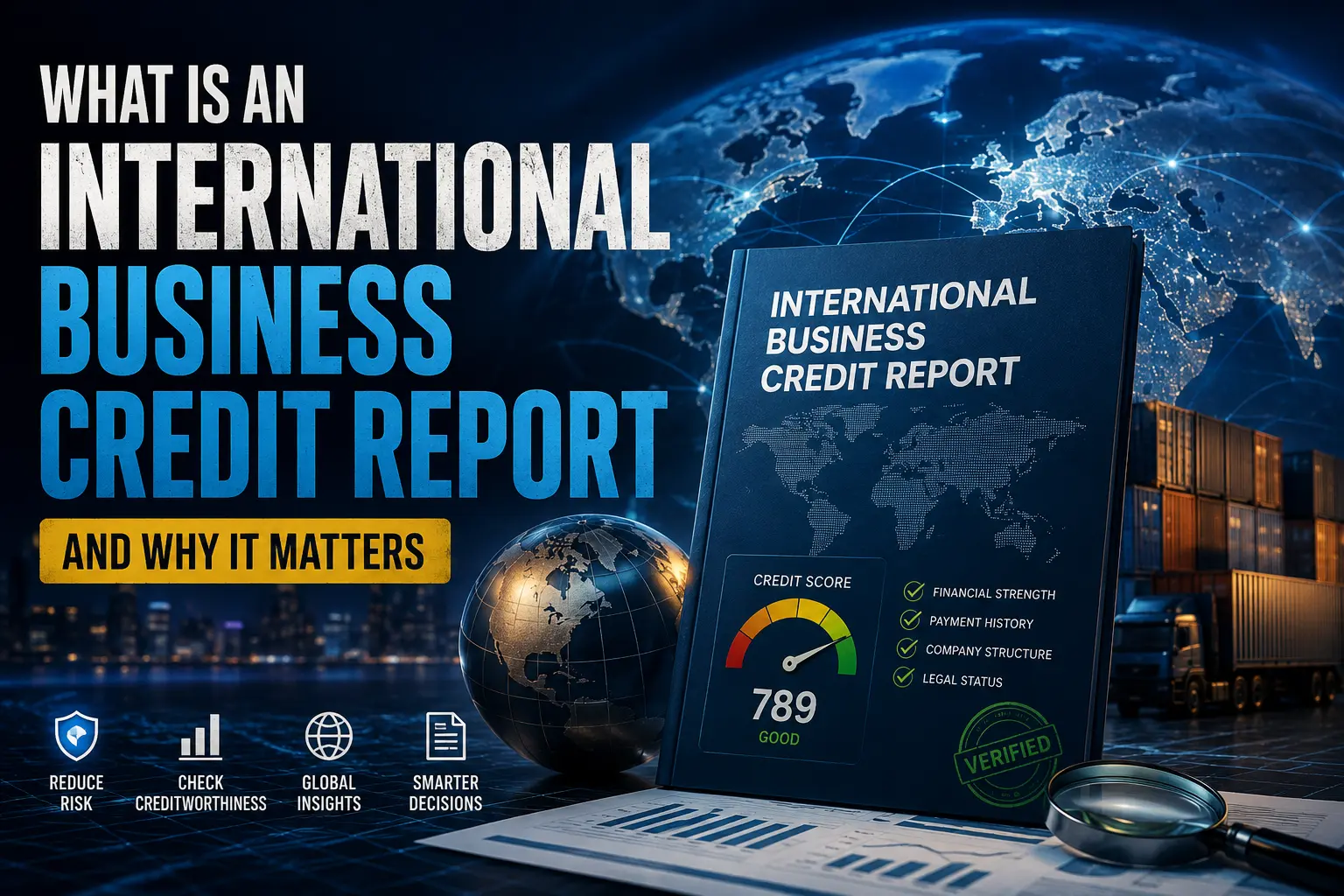
An international business credit report is a verified intelligence file on a foreign legal entity — covering its payment behavior, financial health, corporate structure, and legal standing. Think of it as everything a smart underwriter would want to know before extending a line of credit or signing a business loan agreement, assembled from global sources and localized to the country where that company operates.
These international reports pull from local trade registries, court records, banking data, trade payment contributors, and audited financials where available. The output typically includes an international credit score (sometimes structured as an International A–E Score), a recommended credit limit, corporate linkage data showing every subsidiary, shareholder, and affiliated entity, and a payment history showing exactly how far beyond terms a company has been running.
A company in the UK with mandatory Companies House filings will generate a richer report than one in a market where disclosure is voluntary. That gap in data quality matters, and good reporting services are transparent about it.
Before you dive into international reports specifically, it helps to understand how credit analysis works at the foundation level — the same logic applies whether you're evaluating a domestic borrower or an overseas company.
What's Actually Inside One of These Reports
Credit scores and risk ratings are the first thing most people look at. A standardized international credit score estimates default probability, but the critical thing most people miss is that these scores are calibrated to local norms. A score of 70 in Brazil means something different than the same score in Germany. Always read the methodology for the country, not just the number. Our guide on what is a good credit score number covers how to interpret scoring tiers in context.
Company financials — where mandatory disclosure laws exist, you'll see balance sheets, revenue figures, and profitability ratios. The three numbers I always look at first: debt-to-equity (leverage risk), current ratio (can they meet near-term payments), and Days Sales Outstanding (how fast they're actually collecting). In markets with limited disclosure, these figures are estimated from sourced business data and trade payment contributors rather than audited accounts.
Corporate linkage information is where a lot of deals go sideways. This section maps the full corporate structure — parent companies, subsidiaries, subsidiary relationships, affiliated entities, and detailed shareholder information. Exposure to a subsidiary is often exposure to a stressed parent. The World Bank's ICCR — the international standard setter for credit reporting — has specifically identified ownership transparency as the foundational element it is. If you're evaluating a founder-led LLC or firm abroad, the distinction between business credit vs personal credit becomes critical at this stage.
Payment history and payment trends are where I spend most of my time. Days Beyond Terms (DBT) across multiple trade payment contributors tells you far more than any score. A company paying 45+ days beyond terms isn't in trouble occasionally — it's in trouble structurally. The FCIB/NACM international credit report network builds this history from real on-the-ground creditor surveys, not just international database reports pulled from a static archive. That distinction matters enormously in markets where registry data lags reality by months.
Legal filings and bankruptcy records round out the picture. A company that went bankrupt in one jurisdiction and re-incorporated next door is a real pattern. Corporate status information and historical credit reporting data are the only reliable way to catch it.
Why This Is Nothing Like Pulling a Domestic Credit Report
Domestic business credit reports work because the infrastructure exists: centralized registries, standardized financial disclosure, predictable payment norms. Pull a traditional credit report on a US company and you're working with reasonably consistent data.
Pull an international business credit report on a company in Indonesia, Nigeria, or even parts of Eastern Europe and you're working with a completely different environment. The World Bank's cross-border credit reporting research documents exactly how fragmented credit infrastructure remains across jurisdictions — and the gap is widest precisely where the growth opportunity is biggest.
Three specific problems trip people up. First, currency and conversion risk — when a company's financials are denominated in a local currency, converting to USD can dramatically distort ratios depending on exchange rate timing. Second, cultural payment norms — the Atradius Barometer for Asia found that 46% of all B2B credit sales across Asian markets are hit by payment delays. A DBT of 30 days might be a red flag in Germany; it might be business as usual in a market where 60-day delays are normal. Third, entity matching accuracy — a company name transliterated from Arabic or Cyrillic can generate a completely wrong record. Always cross-reference the registration number, not just the name.
Understanding what lenders actually look at in credit analysis helps explain why these inputs matter so much — the Five C's framework applies internationally, but the data quality to answer those questions varies enormously by country.
A $47,000 Lesson in Why the Report Matters
Here's a scenario I've seen more than once. A small business owner — running a US industrial distributor with about a dozen international customers — signs a 90-day net terms contract with a new buyer in Eastern Europe. Good website, professional emails, a reference from a mutual supplier. No business credit report is pulled. No credit monitoring is set up.
By day 75, the buyer goes dark. By day 120, the account is written off. The billing loss: $47,000.
A full international business credit report would have cost $150 to $300 and 48 hours. It would have shown a 60+ day DBT pattern across three prior trade payment contributors, a recent bankruptcy proceedings judgment from a German supplier, and corporate linkage data tracing the company back to a holding entity with no audited financials and no verifiable corporate status information in any registry. There were also business identity monitoring flags showing the registered address had changed three times in 18 months.
The ICC Trade Register — which covers over $25 trillion in trade finance exposures — finds that when defaults happen, they consistently trace back to "well-known commercial, geopolitical or macroeconomic factors." The warning signs almost always existed. The credit reporting intelligence just wasn't gathered.
The cost of pulling an international business credit report is a fraction of the cost of a single uncollectable receivable.
Which Providers Are Worth Using
The choice of provider depends on where your international risk is concentrated and how fresh you need the data.
Experian business credit international products are tiered — Risk Check through full Company Profile — with strong coverage across North America, Europe, and Latin America. Canadian reports and real-time credit score changes monitoring make it particularly strong for U.S. enterprises with North American cross-border activity. Developed markets deliver reports immediately; emerging markets take 48 to 72 hours.
Dun & Bradstreet is the infrastructure standard. Their D-U-N-S Number is recognized by the European Commission, the United Nations, and 50+ global trade associations as the cross-border business identification standard. The PAYDEX score and corporate linkage information covering subsidiary relationships and affiliated entities are among the most cited metrics in commercial underwriting. NACM distributes D&B reports through its regional chapters.
Creditsafe standardizes international credit scores across all countries — one methodology, direct comparison — and is particularly useful for companies running portfolio-level credit reviews across many international companies at once.
Equifax international products integrate industry benchmarking alongside company risk scores. Their business credit profile outputs include full corporate structure and affiliated entities data.
FCIB/NACM is the go-to for trade credit professionals who need freshly investigated sourced business data rather than database pulls. FCIB reports are built from real on-the-ground bureau networks across additional countries — Routine, Rush, and Super Rush turnarounds available. For overseas customers in markets where registry data is thin, this is the standard.
Compliance: The Part Most People Overlook
An international business credit report isn't just a credit tool — it's a compliance tool. The corporate linkage data, detailed shareholder information, and international ownership information in a full credit file is exactly what your Know Your Business (KYB) process needs.
Under OFAC's 50% rule, any entity owned 50% or more by a sanctioned party is considered sanctioned even if it's not on a list by name. That makes corporate linkage information a compliance necessity. And with AML enforcement fines up 417% year-over-year in H1 2025 — $1.23 billion across 139 enforcement actions globally — the compliance argument isn't theoretical anymore. When a cross-border credit decision results in denial, understanding adverse action letter requirements also becomes essential for US-regulated entities.
How to Actually Use These Reports
Run a business credit report on every new overseas customer before extending trade credit. Set a minimum credit score threshold for automatic approval, a middle band for manual credit reviews, and a hard floor where you require prepayment regardless of how good the relationship feels.
Use the recommended credit limit from the report as a starting point, then adjust for deal size, relationship length, country risk tier, and industry concentration. Our credit risk analytics guide walks through the full framework for that calculation.
Screen your suppliers, not just your customers. Supplier insolvency disrupts your supply chain as badly as a customer default hits your receivables. The same international business credit report process applies.
And don't make the mistake of treating a one-time report as permanent coverage. Set business credit monitoring on high-value accounts — automated financial updates and credit score changes alerts catch deterioration months before a payment problem surfaces. High-exposure relationships should be re-screened quarterly; moderate exposure annually.
If your clients are working to build their own business credit profile ahead of funding, our guide on how to build business credit is worth sending their way.
Frequently Asked Questions
How do I get an international credit report? Contact Experian, Dun & Bradstreet, Creditsafe, Equifax, or FCIB/NACM directly. Submit the company's full legal name, registration number, and country of incorporation. Most reporting services offer both portal access and API integration.
What does it cost? A quick international credit score check runs $30 to $75. A full business credit profile with financials and corporate linkage data typically costs $100 to $300. Freshly investigated FCIB reports for emerging markets carry a premium but deliver far better sourced business data than static international database reports.
What's a business credit score? It's a numerical rating — assigned to any company, LLC, or corporation — estimating how likely that entity is to meet its payment obligations. In the US, scores come from Dun & Bradstreet (PAYDEX), Experian, and Equifax. International credit scores calibrate the same logic to local payment trends and trade payment contributors. For a deeper breakdown, see how credit scores really work.
How is trade credit different from a business loan? Trade credit is a supplier extending payment terms — goods now, money later — which functions as short-term financing between businesses. A business loan involves formal underwriting, deposit requirements, and scheduled repayment of capital plus interest. Trade credit decisions lean heavily on business credit reports and credit monitoring; solid business credit reputation and good credit health unlock favorable financing options and favorable business credit terms that simply aren't available without a clean credit profile.
The Bottom Line
An international business credit report is the difference between informed credit decisions and expensive surprises. It doesn't matter whether you're a small business owner with a handful of international customers or a mid-market company expanding into global markets — the international risk is real, and $24 trillion in annual global trade means there's no shortage of counterparties who want to extend your credit limit before you've checked their credit file.
Business credit intelligence — whether for a new supplier relationship, a potential investor partnership, or an international business acquisition — is the foundation of every financial decision that doesn't blow up in your face. The business growth opportunities in international business are real. So is the global risk for businesses that skip the due diligence.
At The Score Machine, we work with credit consultants, loan officers, and funding brokers who treat credit intelligence as a system, not an afterthought. Explore what the platform can do or get started free today.
Sources
- WTO World Trade Statistics 2024
- Atradius Payment Practices Barometer — US 2024
- Atradius Payment Practices Barometer — Asia 2024
- ICC Trade Register 2024
- World Bank — ICCR
- World Bank — Cross-Border Credit Reporting
- FCIB/NACM International Trade Credit Reports
- NACM Intermountain — FCIB Reports
- Wikipedia — D-U-N-S Number
- OFAC Sanctions & KYB — 50% Rule
- Alloy — AML Compliance Trends 2025
Ali Badi is the founder of ADR Wealth Advisors LLC and The Score Machine, a credit intelligence and institutional readiness platform. With over a decade in bank underwriting and credit risk analysis, he works with professionals across the credit ecosystem to build data-driven, defensible credit decisions.