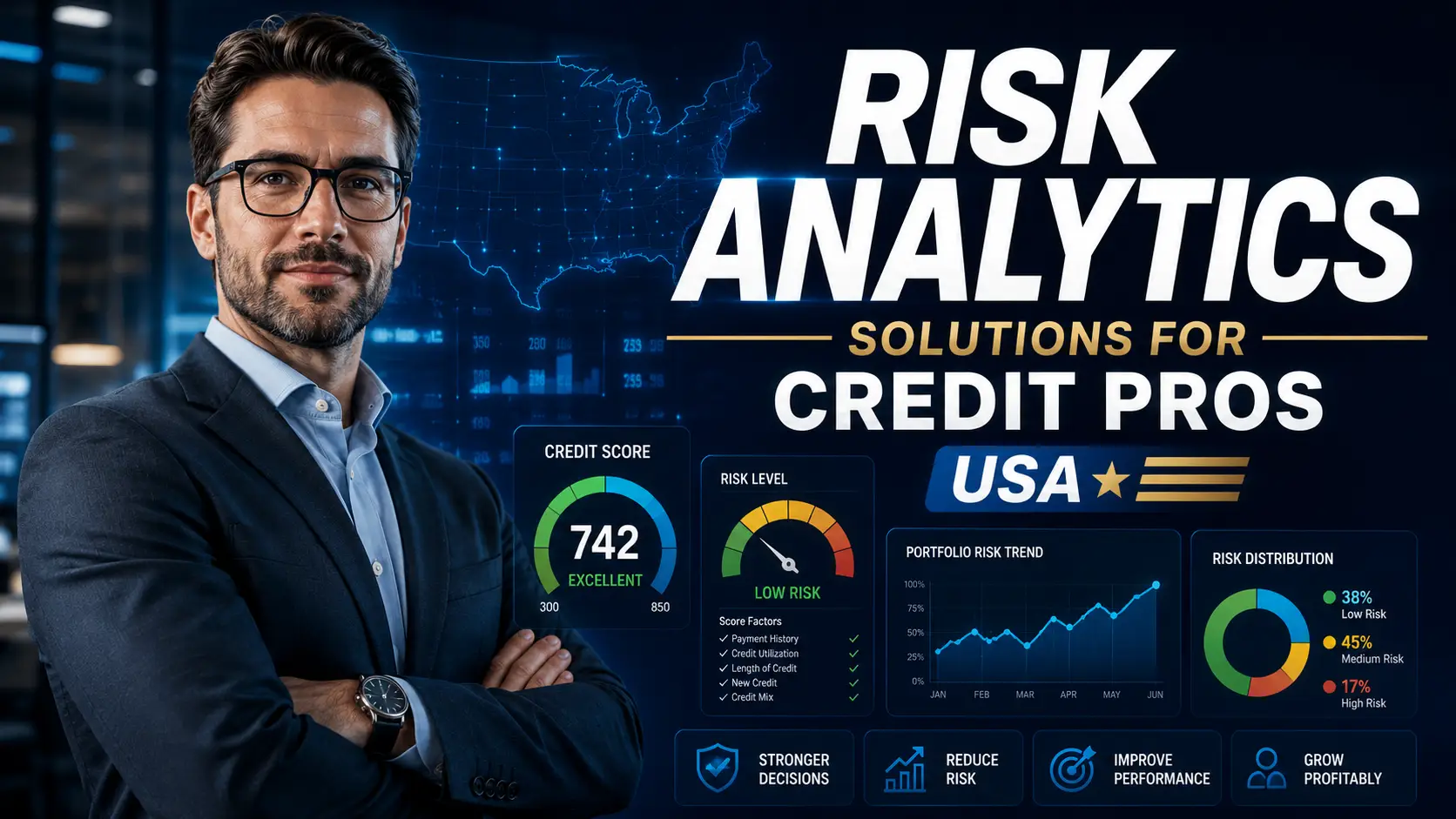
Most risk analytics solutions were built for banks. Not for you. Whether you're a credit consultant in Atlanta, a loan officer in Houston, a funding broker in Los Angeles, or a credit repair professional in Chicago — when the wrong tool ends up in your hands, the result isn't just wasted money. It's missed approvals, misread files, and clients who deserved a better outcome.
Picture this: a client walks in with a 591 score. You can see it's low. There are collections, some late payments, a few inquiries. But you don't know which bureau is hurting them most. You don't know whether those collections are past the HIPAA dispute window. You don't know if paying that charge-off will help or trigger a re-aging event. And you have no clear picture of which lenders they could get approved with right now versus 60 days from now with the right moves.
That gap — between raw data and actionable strategy — is exactly what risk analytics is supposed to close. Data analytics turned credit from an art into a science, but most tools stopped short of making that science usable at the practitioner level. This article breaks down what risk analytics actually means for independent credit professionals across the United States, why traditional solutions get it wrong, how AI is changing the game, and what to look for when you're evaluating options for your business.
What Are Risk Analytics Solutions — And Why the Old Definition Doesn't Apply to You
The textbook definition: risk analytics is the process of turning credit data into measurable risk metrics — Probability of Default (PD), Loss Given Default (LGD), Exposure at Default (EAD) — so institutions can make better lending decisions. If you want the full academic picture, we've covered it in our guide to how lenders measure borrower risk. But that framework was built for Chief Credit Officers at $50 billion commercial banks — and the credit risk management market has grown to over $44 billion in 2026, almost entirely driven by enterprise-level institutional demand.
Traditional scorecards were built to rank consumers, not to help credit professionals build strategy. Risk intelligence — the kind that actually drives results at the practitioner level — isn't reserved for institutional investors in New York or San Francisco anymore. AI made it accessible for every independent professional, from Miami to Minneapolis, from Dallas to Detroit. But only a handful of platforms were built with those professionals in mind.
For credit consultants, loan officers, credit repair professionals, and funding brokers working across the United States, credit risk means something far more practical: approval risk. It's the risk that your client in Phoenix gets declined for the business line of credit they qualify for. It's the risk of submitting a funding package in Denver before the file is ready. It's the risk of targeting the wrong bureau with the wrong lender in Charlotte. Understanding the full scope of credit analysis is step one — but translating that into strategy is where risk analytics solutions earn their place.
Risk analytics has a longer history than most people realize — but the shift toward AI-powered, practitioner-facing tools is happening right now across every city in America, and it's changing how independent professionals compete.
Key Insight: Risk analytics isn't just for Wall Street banks anymore. AI made it accessible for credit professionals in every US city — but only a handful of platforms were actually built with practitioners in mind.
The 5 Things Traditional Risk Analytics Solutions Get Wrong for Credit Pros

The top risk analytics platforms in the market — Bloomberg, Moody's, SAS, Experian's enterprise suite — are genuinely powerful. We've reviewed the best risk management tools currently on the market if you want a direct comparison. But when you evaluate them through the lens of a credit consultant or funding broker operating anywhere from Seattle to Jacksonville, they fail in five consistent ways.
1. They're Built for Enterprises, Not Independent Professionals
Bloomberg Terminal runs $24,000–$27,000 per seat per year. SAS Credit Risk Management implementations start around $500,000 and take 6 to 18 months to deploy. These platforms assume you have an IT department, a model validation team, and a compliance function. That's not a realistic entry point for an independent credit professional running a firm in San Antonio, Columbus, or Nashville.
2. They're Diagnostic, Not Prescriptive
Enterprise tools are great at telling you a client is high risk. They're terrible at telling you what to do about it. Knowing the key components of credit analysis is the first step — but translating those key risk factors into a prioritized action sequence is where most platforms go silent. A risk score is not a strategy — whether you're in Boston, Baltimore, or Baton Rouge.
3. They Treat Credit as a Single-Bureau Snapshot
Most tools aggregate credit data into one number or one risk tier. That completely misses how lending decisions actually work. A client with a 660 at Experian and a 598 at Equifax is not a "630 average risk." They're an approvable client at the right lender who pulls the right bureau — and a declined client at the wrong one. According to FICO, their scores are used by 90% of top lenders — but which bureau version gets pulled varies significantly by lender and product. Bureau-level risk stratification matters enormously across every US market, and almost no traditional platform addresses it for practitioners.
4. They Ignore Thin-File and Credit-Invisible Borrowers
A massive share of the clients credit professionals work with — especially in high-immigration cities like Los Angeles, New York, Miami, and Houston — don't have enough data for most risk models to produce meaningful output. Traditional systems return "insufficient data" and move on. That's not useful when you're trying to build a client's file from scratch. Without instinct-based risk management — which is essentially what you're left with — thin-file clients simply don't get served.
5. They Don't Connect Dispute Outcomes to Risk Movement
Run a dispute round, remove a collection, watch the score move. But by how much should it move? Which bureau needs rechecking first? What's the next highest-impact action? Traditional tools don't create a feedback loop between dispute activity and forward-looking credit risk assessment. Under Section 611 of the Fair Credit Reporting Act (FCRA), consumers have the right to dispute inaccurate information — but knowing what to dispute and when requires analytics that most tools simply don't provide.
How AI-Powered Risk Analytics Solutions Work (And What Carmela Actually Does)
Advanced analytics used to mean a Bloomberg Terminal and a PhD at a Manhattan hedge fund. AI changed that — for professionals in every zip code across the US. The shift isn't just about speed — it's about the type of insight AI produces versus what a human analyst working sequentially can realistically catch.
A 2024 McKinsey survey found that 52% of financial institutions have positioned generative AI as a priority for their credit business — with early warning systems and underwriting topping the list of applications. That momentum is now moving downstream to the independent professional market in cities like Memphis, Albuquerque, Tucson, and Fresno, and the tools are finally catching up.
When a human reviews a credit file, they scan the summary, note the scores, look at the negative accounts, check utilization, and form an impression. It's linear and experience-dependent. An AI system reads the entire file simultaneously — every tradeline, every inquiry, every account age, every balance — and identifies patterns across all variables in combination. That's what enables dynamic risk assessment rather than a point-in-time snapshot.
Here's what that looks like in practice: a client has 37% average utilization. A human analyst sees that and notes it's above the 30% threshold. The AI sees the 37% average is driven by one card at 89% utilization reporting only to Equifax, while three other cards sit near zero. A targeted paydown on that one card drops the highest-impact tradeline below 10% — and the AI predicts the score impact before you make the move. That's risk prediction functioning as a planning tool, not just a diagnostic.
Carmela — The Score Machine's AI credit analysis engine — enables exactly this kind of proactive risk management for credit professionals nationwide. Here's what it analyzes:
- Bureau-specific key risk indicators across Equifax, Experian, and TransUnion simultaneously
- Negative item ranking by score improvement potential — not just presence
- Utilization imbalances at the individual tradeline level, including hidden risks in single-bureau reporting
- Inquiry clustering patterns that signal risk to underwriters even when scores appear acceptable
- Payment history trends and account age distribution that affect credit risk assessment
- A fundability roadmap — the prioritized sequence of actions most likely to move a client toward approval
Here's a real-world scenario: a funding broker in Dallas runs a small business owner's file before packaging the application. Scores look borderline — 634 Experian, 621 Equifax, 618 TransUnion. Carmela flags a medical collection on Equifax only, $847, past the HIPAA dispute threshold. It also identifies the Experian file is clean enough to target card issuers who exclusively pull Experian. The broker disputes the Equifax collection, waits 35 days for deletion, and repackages the file. The Equifax score crosses 640. The application goes through.
That's credit risk analytics functioning as a strategy engine — not a scorecard. If you want to understand how lenders on the other side of the table think about these decisions, our guide to credit analysis in 2026 covers the underwriting mechanics in detail.
Want to see what Carmela surfaces in a real client file? Start your free 14-day trial →
Bureau-Level Risk Stratification: The Insight Most Risk Analytics Solutions Skip
Your client doesn't have one credit profile. They have three — one at Equifax, one at Experian, one at TransUnion — and they can look completely different. This is true whether your client is in New York City or New Orleans, Portland or Pittsburgh.
Different creditors report to different bureaus. A collections account on Equifax might not exist on Experian. A late payment disputed and removed at TransUnion might still be live at the other two. Account ages, balances, and inquiry counts vary significantly depending on which creditors are involved and when data was last updated.
Risk volatility between bureaus is one of the most common and least-discussed risk factors in client profiles. And yet almost no traditional risk analytics solution surfaces it at the bureau level for practitioners.
The stakes are real: what qualifies as a good credit score varies by product and lender. Experian defines a good FICO score as 670–739, but individual lenders set their own cutoffs — and a client sitting at 660 Experian / 598 Equifax is approvable at the right lender on the right bureau, and declined everywhere else if you submit blindly.
| Bureau | Who Pulls It Most | Key Risk Signals | Strong Markets |
|---|---|---|---|
| Equifax | Mortgage & auto lenders; many card issuers in Southern/Midwest US markets | Payment history depth, collections age, judgment records | Atlanta, Dallas, Houston, Charlotte, Nashville |
| Experian | Major national banks & premium card issuers; often the cleanest file for clients actively disputing | Soft inquiry tracking, extended credit history, account tenure | Los Angeles, New York, Chicago, San Francisco, Boston |
| TransUnion | Fintech lenders, BNPL providers, credit unions; strong for employment screening | Employment data, trended credit data, recent account activity | Seattle, Denver, Minneapolis, Portland, Austin |
A strong risk analytics solution doesn't average these together — it shows you where the client is strong, where they're weak, and which bureau to prioritize based on the specific product you're pursuing. That's the difference between a proactive risk management strategy and a guessing game — in every US city.
For a credit consultant doing dispute work in Miami or Milwaukee, bureau stratification means sequencing your rounds by impact — leading with the bureau that matters most for the client's next financial goal, not just targeting the worst items across all three simultaneously.
For a funding broker in Philadelphia or Phoenix building a credit card approval strategy, it means matching each application to the lender most likely to pull the client's strongest bureau. That's the difference between a 3-approval day and a 7-approval day. The credit score thresholds needed for business loans vary by lender — and knowing which bureau they'll pull changes how you sequence the work.
Key Insight: Bureau stratification is one of the most overlooked risk factors in credit strategy. The Score Machine's analytics surface it automatically, so you're never guessing which file to clean first — no matter what city you're in.
Risk Analytics for Thin-File and Credit-Invisible Clients: What Good Solutions Handle
A significant share of the clients credit repair professionals, loan officers, and funding brokers work with across the US don't have a robust credit file. They might be a first-generation entrepreneur in Los Angeles or Miami who built a cash business for a decade. A recent immigrant in New York, Houston, or Chicago with foreign credit history that doesn't transfer. A 23-year-old in Atlanta or Phoenix trying to qualify for their first business line. A freelancer in Austin or Nashville whose income is real but whose credit footprint is minimal.
Traditional risk analytics tools essentially have nothing to say about these clients. No score, no history, no output. But thin-file doesn't mean high-risk. It means unread.
This gap is growing nationwide. According to LexisNexis Risk Solutions' 2026 Credit Trends report, a K-shaped economy is driving more consumers across the US to seek credit — many with thin credit histories — which means the demand for analytics solutions that handle sparse files is accelerating in every market from coast to coast.
AI-powered solutions that are built for credit professionals approach thin-file clients differently. Instead of returning an error, they identify what's there and what it signals:
- Are there any open tradelines? What's the age and payment status?
- Is there an authorized user account providing historical depth?
- Are there utility or rent payment records feeding into bureau data?
- Is there a secured card or credit-builder account showing positive payment patterns?
- What fraud detection flags, if any, are suppressing the profile unfairly — and are they disputable?
- What's the fastest path to a scoreable file based on what currently exists?
For a credit consultant in San Diego or St. Louis, this kind of output turns a "can't help you yet" conversation into a "here's your 90-day plan" conversation. For clients starting from scratch, building business credit is often the fastest path to a fundable profile — and good analytics identifies that path even when the starting point is almost zero.
For business funding clients, the distinction between business and personal credit shapes the entire strategy. A strong risk analytics solution surfaces which profile to lead with and in what order. See the Credit Readiness section of The Score Machine for how this plays out in practice.
What to Look for in a Risk Analytics Solution (If You're Not a Bank)
If you're building a real risk management program for your credit business — whether you're operating out of Tampa, Tucson, Toledo, or Tacoma — the criteria that matter to a bank's Chief Credit Officer don't apply to you. Here's what actually does:
| What to Look For | Why It Matters for Your Risk Management Program |
|---|---|
| Prescriptive output | Ranks key risk factors and tells you which to address first for maximum score impact |
| Multi-bureau visibility | Breaks down dynamic risk assessment across Equifax, Experian, and TransUnion separately |
| AI analysis layer | Advanced analytics that surfaces hidden risks a manual line-by-line review would miss |
| Dispute workflow integration | Connects risk flags to a direct remediation workflow — not just a data dump |
| Thin-file capability | Builds a risk strategy even when the credit file is sparse or unscored |
| Multi-client management | Lets consultants and loan officers run risk monitoring dashboards across a full book of clients |
| Accessible pricing | No $500K implementation — built for independent professionals and small firms in any US city |
| Built-in tools | Includes calculators, templates, and guides so data insights translate to client action |
| Nationwide applicability | Works for clients and professionals across all 50 states — no regional limitations |
| Cloud-based access | Log in from anywhere — New York, Nevada, or North Dakota — no software installation needed |
Stack The Score Machine against that checklist and it holds up across every line. It was built for the exact professionals described throughout this article — not adapted from an enterprise platform. Prescriptive output, multi-bureau analysis, Carmela's AI layer, dispute workflow integration, multi-client management, and accessible pricing for professionals in every US market. Explore the full platform features and the funding calculator to see the full toolkit.
Ready to evaluate it yourself? See the full platform →
How Credit Professionals Across the USA Are Using Risk Analytics to Close More Deals

The best way to understand practical value is to see it across different professional contexts — from coast to coast.
The Credit Consultant (Atlanta, GA)
Maria runs a credit consulting firm in Atlanta with about 40 active clients at any given time. Her old workflow was manual: pull reports, scan for negatives, write dispute letters, wait, rescan. No systematic way to prioritize which clients were close to a breakthrough versus which ones needed months more work — classic instinct-based risk management.
After integrating AI-powered risk analytics into her practice, she runs every new client through an intake analysis that ranks them by fundability trajectory. Portfolio effects were immediate — her close rate improved because she stopped working the wrong files in the wrong order. How to increase a client's credit score quickly becomes a far more answerable question when analytics surfaces the three highest-impact moves first.
The Loan Officer (Houston, TX)
James is a loan officer in Houston who sees a lot of applications kicked back by underwriting — not because the borrower isn't creditworthy, but because the file wasn't packaged at the right moment. He started running preliminary credit risk assessments before formally submitting files. If analytics show the client is 30 days from a meaningful score improvement, he tells them to wait. His underwriter approval rate went up because he stopped submitting files that weren't ready. See the Loan Preparation resources for the specific thresholds that matter most in 2026.
The Funding Broker (Los Angeles, CA)
Priya specializes in business funding in Los Angeles — $50,000 to $250,000 in credit card funding for small business clients. Bureau-level risk stratification changed her process completely. She maps each client's strongest bureau, cross-references it against known issuer pull patterns, and sequences applications starting with lenders most likely to pull where the client is cleanest. Her average approvals per client went up significantly. When alternative business funding routes come into play, she already knows which credit profile to lead with.
The Credit Repair Professional (Chicago, IL)
Devon runs a credit repair operation in Chicago using a multi-round dispute system. His challenge wasn't running disputes — it was knowing when to move from one item to the next, and whether outcomes were actually translating to score movement. The CFPB's FCRA guidance gives consumers rights in the dispute process — but rights without strategy don't close deals. With risk monitoring dashboards tracking each client's bureau-specific risk profile over time, he can see exactly how score movement correlates with completed dispute rounds. How paying off a collection affects your score isn't always what clients expect — and analytics flags when a deletion isn't producing the anticipated impact so he knows what's suppressing it.
The Score Machine Serves Credit Professionals in Every Major US City
The Score Machine is a nationwide platform built for credit professionals across all 50 states. Whether you're serving clients in large metros or mid-size markets, the platform works the same way everywhere — because credit bureaus, FCRA rules, and lending decisions work the same way everywhere.
Major metro markets served include:
Northeast: New York City, NY · Philadelphia, PA · Boston, MA · Baltimore, MD · Washington DC · Newark, NJ · Hartford, CT · Providence, RI · Buffalo, NY · Albany, NY
Southeast: Miami, FL · Atlanta, GA · Charlotte, NC · Tampa, FL · Orlando, FL · Jacksonville, FL · Raleigh, NC · Nashville, TN · Memphis, TN · Virginia Beach, VA · Richmond, VA · New Orleans, LA · Birmingham, AL · Louisville, KY · Greensboro, NC
Midwest: Chicago, IL · Detroit, MI · Columbus, OH · Indianapolis, IN · Milwaukee, WI · Cleveland, OH · Minneapolis, MN · St. Louis, MO · Cincinnati, OH · Kansas City, MO · Omaha, NE · Des Moines, IA · Grand Rapids, MI · Akron, OH · Toledo, OH
South/Southwest: Houston, TX · Dallas, TX · San Antonio, TX · Austin, TX · Fort Worth, TX · El Paso, TX · Oklahoma City, OK · Tulsa, OK · Little Rock, AR · Baton Rouge, LA · Shreveport, LA · Corpus Christi, TX · Laredo, TX · Lubbock, TX
Mountain/West: Phoenix, AZ · Denver, CO · Las Vegas, NV · Albuquerque, NM · Tucson, AZ · Colorado Springs, CO · Salt Lake City, UT · Mesa, AZ · Scottsdale, AZ · Chandler, AZ · Reno, NV · Boise, ID · Spokane, WA
West Coast: Los Angeles, CA · San Francisco, CA · San Diego, CA · Seattle, WA · Portland, OR · San Jose, CA · Sacramento, CA · Fresno, CA · Long Beach, CA · Oakland, CA · Bakersfield, CA · Anaheim, CA · Riverside, CA · Stockton, CA · Irvine, CA
No matter your market, The Score Machine's AI credit analysis, bureau stratification, and fundability tools work for your clients and your workflow.
Start Using a Risk Analytics Solution Built for You — Anywhere in the USA
The clients you serve are counting on you to see things they can't. They don't know which bureau to prioritize. They don't know that paying off an old collection might trigger a re-aging event. They don't know they're 45 days away from crossing a threshold that opens up a whole tier of funding options. Your job — whether you're in Miami or Minneapolis — is to mitigate risk and build a clear path forward. The right analytics solution is what makes that possible.
The Score Machine gives you AI-powered credit risk assessment through Carmela, bureau-level risk stratification, dispute resources, funding strategy tools, credit calculators, and a template library — all built specifically for credit consultants, repair professionals, loan officers, and funding brokers operating anywhere across the United States. Not a scaled-down enterprise tool. Not a credit monitoring app. A data-driven platform designed for the way you actually work.
Sign up at thescoremachine.com and analyze your first client file — from any city in America. See what Carmela surfaces. Then decide if you've been leaving insights — and approvals — on the table.
Create your free account — no credit card required. Start your 14-day free trial →
Frequently Asked Questions
What is a risk analytics solution for credit professionals in the USA?
A risk analytics solution is a tool or platform that converts raw credit data into actionable insights about a borrower's creditworthiness and fundability. For credit professionals across the United States, this means understanding which risk factors are suppressing a client's score, which bureau presents the strongest profile, and what sequence of actions will move them toward approval most efficiently — regardless of what city or state you and your clients are in.
How is AI changing credit risk analytics for US-based professionals?
AI enables dynamic risk assessment of hundreds of data points across a credit file simultaneously — tradeline balances, utilization ratios, inquiry patterns, account ages, bureau-specific reporting differences — and produces prescriptive output rather than just a risk score. McKinsey's research shows institutions that have operationalized AI in credit scoring are already generating measurable efficiency advantages. That same advantage is now available to independent credit professionals nationwide through platforms like The Score Machine.
Do I need enterprise software for proper risk analytics?
No. Enterprise platforms were built for institutional compliance and regulatory capital management. Independent credit professionals in cities across the US need a different kind of solution — one that's accessible, practitioner-facing, and built around fundability strategy rather than portfolio-level risk reporting. Proactive risk advice, prescriptive output, and multi-bureau visibility matter far more than Basel IV compliance modules.
What's the difference between credit scoring and risk analytics?
A credit score is a single output — a number that summarizes risk at a point in time. FICO scores range from 300–850 and are used by 90% of top lenders, but the score alone doesn't tell you what's driving it or what to do next. Risk analytics is the process behind it: understanding what's driving the score, how it differs across bureaus, what's most likely to change it, and how it maps to real-world approval decisions. This applies the same way whether you're in New York or New Mexico.
How does bureau stratification improve funding outcomes for US clients?
Different lenders and card issuers across the US pull different bureaus, and a client's risk profile can vary significantly between Equifax, Experian, and TransUnion. Bureau stratification means identifying where your client is strongest and sequencing credit applications toward lenders who pull that bureau. This single variable can mean the difference between three approvals and seven on the same application day — in any US market.
Is The Score Machine available nationwide?
Yes. The Score Machine is a cloud-based platform available to credit professionals and their clients across all 50 US states. Whether you're operating in major metros like New York, Los Angeles, Chicago, Houston, and Miami — or in mid-size markets like Raleigh, Salt Lake City, Omaha, or Baton Rouge — the platform works the same way everywhere. Credit bureau data, FCRA rules, and lending standards are federal — and so is The Score Machine.
About the Author
Ali Badi is the CEO and Credit Risk Strategist at The Score Machine. With over five years of experience in credit analysis, risk assessment, and funding strategy, Ali helps credit consultants, loan officers, and funding brokers across the United States build data-driven practices through AI-powered tools and institutional-grade credit intelligence.