Quick answer: The core requirements for a commercial loan are a 680+ personal credit score, a 1.25x debt service coverage ratio (DSCR), a 20–30% down payment, acceptable collateral, at least 2 years in business, and 2–3 years of financial documents. Meet those six, and you're fundable at most lenders. The rest of this guide shows you exactly how.
Applying for a commercial loan can feel like a mystery. You hand over a mountain of paperwork, wait weeks, and hope someone behind a desk says yes.
Here's the thing though — it's not a mystery at all.
Lenders follow a surprisingly predictable playbook, and once you understand the requirements for a commercial loan, you can walk in already knowing whether you'll get approved. That's exactly what we're going to break down for you: the credit scores, the cash flow numbers, the down payment, the collateral, and the exact documents lenders want to see — whether you're after a small business loan or a seven-figure commercial mortgage.
Let's get into it.
Quick note before we start: this article is part of our complete Business Credit & Funding Guide — bookmark that one if you want the full roadmap, from building credit to getting funded.
In this guide:
- What Lenders Look For (The Five C's)
- Credit Score Requirements
- Cash Flow and DSCR Requirements
- Down Payment, Collateral, and LTV
- Basic Eligibility Requirements
- Types of Commercial Loans
- Documentation Checklist
- FAQ
What Lenders Look for in a Commercial Loan Application
Every lender, from your local bank to a big national institution, evaluates commercial loan requirements through the same framework: the Five C's of Credit.
Think of these as five chapters of your business's story. A weak chapter makes a lender pause. A strong one builds the confidence they need to say "yes."
- Character: Your reputation. Do you pay your debts on time? Lenders check your personal and business credit reports to find out.
- Capacity: The big one — can you actually afford the payments? This is where cash flow and your Debt Service Coverage Ratio (DSCR) come in.
- Capital: How much of your own money is in the business. Skin in the game matters.
- Collateral: Assets you pledge — real estate, equipment, receivables — that protect the lender if things go wrong.
- Conditions: The bigger picture. What's the loan for? What's happening in your industry and the economy?
The Five C's at a Glance
| The 'C' | What Lenders Want | How to Prepare |
|---|---|---|
| Character | Proof you honor your obligations | Clean personal and business credit reports |
| Capacity | Cash flow that comfortably covers the loan | Strong financials and a healthy DSCR |
| Capital | Your own money invested | Documented equity and a ready down payment |
| Collateral | A backup source of repayment | Appraised assets you can pledge |
| Conditions | A sensible purpose and market fit | A business plan that addresses the risks |
One more thing before we go deeper: lending standards have tightened. The Federal Reserve's Senior Loan Officer Opinion Survey shows banks getting more cautious with commercial lending across the board. That means meeting the minimum commercial loan requirements isn't enough anymore — you want to clear them with room to spare.
📊 Reality check: The Federal Reserve Banks' annual Small Business Credit Survey consistently finds that only about half of small business loan applicants receive the full financing they apply for — the rest get partial approval or a denial, most often over the same gaps this guide covers: credit, cash flow, and documentation.
Credit Score Requirements for a Commercial Loan
Your credit profile is your financial handshake. It's the very first thing an underwriter looks at, and it sets the tone for everything that follows.
So what's the magic number?
For most traditional lenders, the personal credit score requirement for a commercial loan is 680 or higher. Some banks will consider 660. Alternative lenders may go as low as 600 — but expect higher interest rates in exchange for the extra risk. We break down the numbers lender-by-lender in our guide to the credit score needed for a business loan.
And a strong score doesn't just get you approved. It gets you a better deal:
- Lower interest rates — even a small rate reduction saves thousands over the life of the loan
- Better loan terms — longer repayment periods and more flexibility
- Higher loan amounts — confidence translates directly into dollars
Your Business Credit Report Matters Too
Your personal FICO score is only half the story. Lenders also check your business credit score, pulling reports from Dun & Bradstreet, Experian Business, or Equifax Small Business.
The key metric here is the PAYDEX score from Dun & Bradstreet — a 1 to 100 grade of how you pay your vendors and suppliers. Lenders also look for liens, judgments, bankruptcies, and how much of your available credit you're using.
Wondering which score lenders actually weigh more? Here's our full comparison of business credit vs personal credit for funding.
How to Strengthen Your Credit Before You Apply
If your credit isn't there yet, don't panic. Do this instead:
- Pull both reports and dispute errors. Incorrect late payments or accounts you never opened can quietly drag your score down. Removing them is a quick win.
- Keep utilization under 30%. High balances signal financial strain to lenders.
- Pay everything on time, every time. Payment history is the single biggest factor in your score — personal and business.
Building from zero? Follow our founder's guide to building business credit from scratch — it covers exactly where to open your first trade lines.
Cash Flow and DSCR Requirements
A great credit score gets you in the door. Cash flow is what gets you approved.
This is "Capacity" — and lenders measure it with one number: the Debt Service Coverage Ratio (DSCR).
Here's how it works. Say your total monthly debt payments (including the new loan) come to $10,000, and your business generates $12,500 in net operating income. Your DSCR is 1.25x — meaning you have $1.25 coming in for every $1.00 of debt going out.
That extra 25 cents? That's your safety cushion, and it's exactly what lenders want to see.
Most lenders require a minimum DSCR of 1.25x. Fall below that, and your application is in trouble. A low DSCR is one of the most common reasons commercial loan applications get denied.
Proving Your Cash Flow
To calculate your DSCR, lenders will ask for:
- Profit and loss statements — usually 2 to 3 years, showing consistent profitability
- Business bank statements — the last 3 to 6 months, showing real money moving
- Cash flow projections — realistic forecasts backed by solid assumptions
Quick tip: if you run a seasonal business, address it head-on. Add a short note explaining the peaks and valleys and showing that your annual cash flow more than covers the debt. Don't make the underwriter guess.
Down Payment, Collateral, and LTV Requirements
Now for the part everyone asks about: how much money do you need to bring to the table?
Whether you're funding a real estate acquisition or refinancing an existing commercial mortgage, commercial property loan requirements start with your equity contribution.
Down Payment Requirements
Commercial loans require bigger down payments than residential mortgages. Here's what to expect:
- Owner-occupied commercial property: typically 20–25% down
- Investment property: typically 25–35% down
- SBA 504 loans: as low as 10% down — one of the biggest advantages of SBA financing
Loan-to-Value (LTV) Explained
Lenders won't finance an asset's full value. The loan-to-value ratio caps how much they'll lend against the appraised worth.
Example: you're buying a commercial property appraised at $500,000. At an 80% LTV, the maximum loan is $400,000 — the remaining $100,000 is your down payment. Most commercial real estate loans land between 65% and 80% LTV, and riskier assets like inventory get much lower ratios.
What Counts as Good Collateral
- Real estate — the gold standard; stable and easy to value
- Business equipment — machinery and vehicles, valued by age and condition
- Inventory — accepted, but lenders discount it heavily
- Accounts receivable — unpaid invoices can back a loan through invoice financing
The Personal Guarantee
For most small businesses, there's no way around this one. A personal guarantee is your legally binding promise to repay the debt personally if the business can't — putting your home, savings, and personal assets on the line.
There are two types: an unlimited guarantee (you're on the hook for everything) and a limited guarantee (your liability is capped at a set amount). Read this part of your loan agreement carefully.
What about an unsecured loan — no collateral at all? They exist, but expect smaller amounts, shorter terms, and noticeably higher rates. For most commercial financing, collateral is the price of good terms.
Basic Eligibility: Time in Business, Entity, and Occupancy
Beyond the financials, there are a few threshold requirements for a commercial loan that trip people up because nobody mentions them:
- Time in business: Most banks want at least 2 years in business under existing ownership. Newer businesses usually need to look at SBA programs or alternative lenders. If you're still early, start building business credit now to open up better funding options down the road.
- Business entity: You'll typically need a registered structure — an LLC, S corporation, or similar — not a casual side hustle.
- Owner-occupancy rule: For owner-occupied commercial real estate financing, your business generally must occupy at least 51% of the building. If you won't, you're looking at an investment property loan — a commercial loan for rental property — which comes with stricter terms and a bigger down payment.
Types of Commercial Loans (and How the Requirements Change)
Not all commercial financing looks the same — and neither do the qualification standards.
- Business term loans: A lump sum repaid over a fixed period. Standard commercial loan requirements apply: 680 credit, 1.25x DSCR, solid financials. See how a major bank structures these in our breakdown of Capital One business loans.
- Business line of credit: Flexible working capital you draw as needed. Lighter documentation, faster approval — often 2 to 4 weeks.
- Commercial mortgage / commercial real estate loan: A commercial mortgage loan is for purchasing or refinancing property. Expect the full underwriting treatment — appraisal, environmental review, 20–35% down. Read the commercial real estate loan terms carefully: many carry prepayment penalties like yield maintenance, and some end in a balloon payment — a large lump sum due when the term expires.
- SBA 7(a) loans: The SBA's flagship program, partially guaranteed by the government and issued through an SBA-approved lender. Easier to qualify for, longer terms — but famous for heavy paperwork.
- SBA 504 loans: The go-to SBA loan for commercial property purchases — long-term, fixed-rate commercial real estate financing for major assets like property and equipment, with that attractive ~10% down payment.
- Equipment financing: The equipment itself serves as collateral, so approval leans on the asset's value more than your balance sheet.
- Construction loans: Short-term funding for ground-up builds, drawn in stages as work completes. Expect the strictest documentation of any commercial loan type.
- Bridge loans: Fast, short-term bridge financing that carries you between a purchase and permanent financing. Higher rates, but speed is the point.
- Hard money loans: A commercial hard money loan is asset-based lending from a private hard money lender. Approval is fast and credit-flexible because the decision rests almost entirely on the property — the trade-off is the highest rates in commercial lending.
Where to Get a Commercial Loan
Commercial lenders come in more flavors than most borrowers realize, and requirements shift with each:
- Traditional lenders (banks): Best rates and terms, strictest standards — the commercial loan requirements this guide describes (680 credit, 1.25x DSCR, 2 years in business).
- Credit unions: Often slightly more flexible than banks, with competitive rates for members.
- Online lenders: Faster decisions and lighter paperwork, at higher rates. Good for businesses that miss one bank criterion.
- Nonprofit lenders (CDFIs): Mission-driven lenders serving startups and underserved communities — worth a look if banks say no.
- Hard money lenders: Speed and asset-based flexibility, at premium cost.
Commercial loan rates vary widely across these lender types — banks and SBA programs sit at the low end, online lenders in the middle, and hard money at the top. Your credit profile and DSCR decide where in that range you land. Before you apply, run your numbers through our free funding calculator to estimate what a payment would look like.
Match the loan type to your actual need before you apply. Applying for the wrong product wastes time and adds unnecessary credit pulls.
The Commercial Loan Documentation Checklist
Your paperwork is your first impression. A complete, organized package tells the lender you run a serious operation. A sloppy one is a red flag before anyone reads a single number.
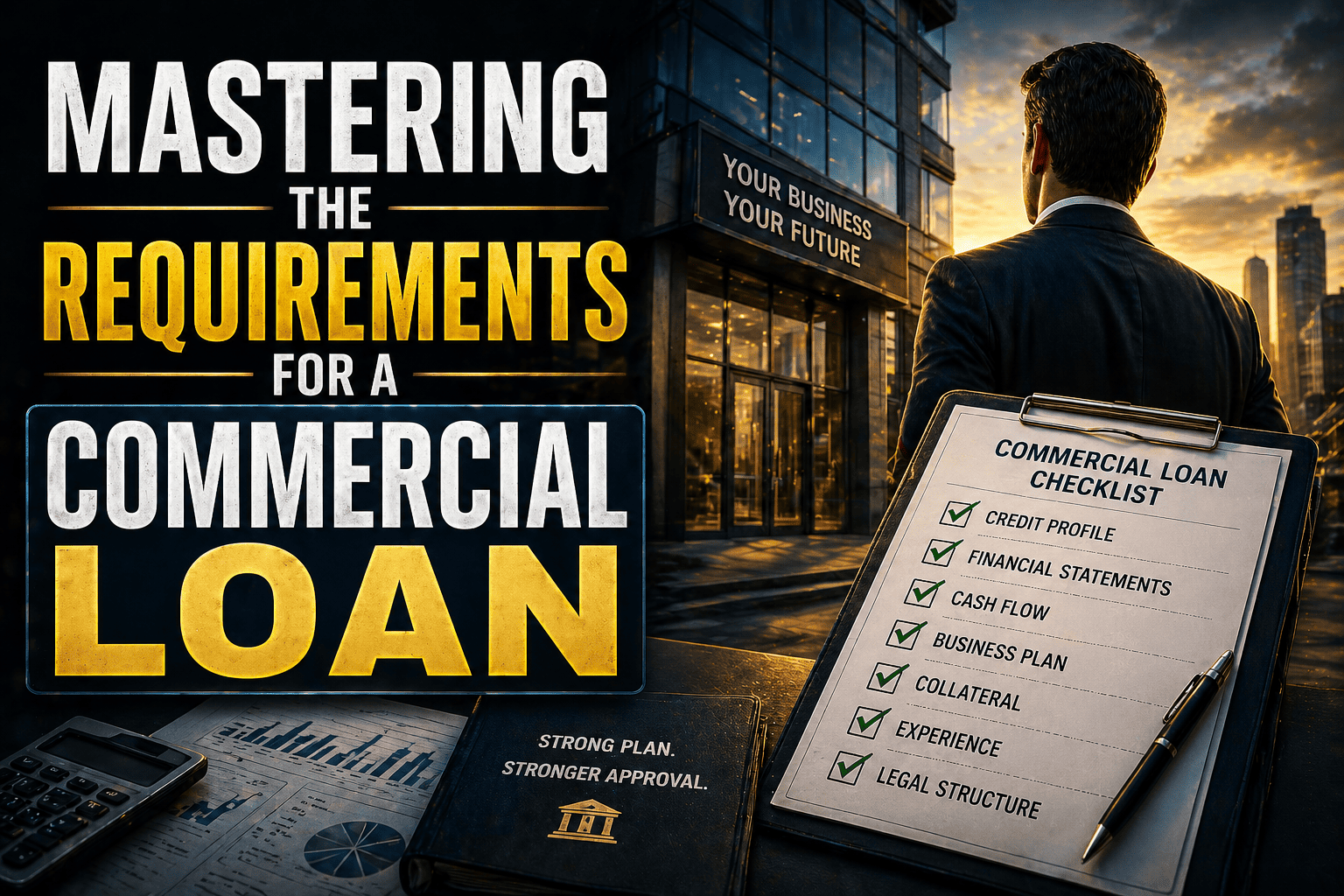
Here's what to gather, in four buckets:
- Personal information: Government-issued ID for all owners, 2–3 years of personal tax returns, and a personal financial statement
- Business financials: 2–3 years of business tax returns, current P&L statements, balance sheets, and 3–6 months of business bank statements
- Legal documents: Articles of incorporation, business licenses, partnership agreements, and industry permits
- Loan-specific items: A business plan explaining the use of funds, cash flow projections, and purchase agreements for any property or equipment
Document Requirements by Loan Type
| Document | SBA Loan | Term Loan | Line of Credit |
|---|---|---|---|
| Personal financials | All owners with 20%+ stake | All guarantors | Primary owners |
| Business plan | Comprehensive, mandatory | Usually required | Use-of-funds summary |
| Cash flow projections | 2–3 years, detailed | 1–2 years | Basic |
| Business tax returns | 3 years | 2–3 years | 1–2 years |
Gather these before you apply. Nearly every delay in commercial lending comes down to missing paperwork.
And once your file is complete, don't sit on it — here's how to get pre-approved and lock in your funding fast.
FAQ: Common Questions About Commercial Loan Requirements
How do commercial loans work?
A commercial loan is business financing repaid from business income, usually secured by collateral. The lender evaluates your credit, cash flow (DSCR), and assets, then sets the commercial loan terms — amount, rate, and repayment period — based on that risk. You repay in monthly installments — sometimes with a balloon payment at the end, depending on the loan structure.
What credit score do you need for a commercial loan?
Most traditional lenders require a personal credit score of 680 or higher. Some banks accept 660, and alternative lenders may work with scores down to 600 — at higher interest rates.
How much down payment is required for a commercial loan?
Typically 20–30% of the purchase price. Owner-occupied properties can qualify at 20–25%, investment properties usually need 25–35%, and SBA 504 loans can go as low as 10%.
What DSCR do lenders require?
The industry standard is a minimum 1.25x DSCR — your net operating income should be at least 25% higher than your total debt payments.
How long do you need to be in business?
Most banks want at least 2 years in business under current ownership. Startups should look at SBA programs or alternative lenders instead.
How long does the commercial loan process take?
A business line of credit can close in 2–4 weeks. SBA loans and commercial real estate loans typically take 60–90 days. Preparation is the biggest variable — complete files move fast.
Can you get a commercial loan with bad credit?
It's harder, but possible. Alternative lenders — like the ones we cover in our Everest Business Funding review — focus more on cash flow than credit history, though expect higher rates and stricter terms. Your best move is improving your score before you apply. Start with our guide on getting financing with a thin credit file.
Get Lender-Ready Before You Apply
Here's the bottom line: mastering the requirements for a commercial loan isn't about secrets. Strong credit, a 1.25x DSCR, a real down payment, solid collateral, and clean paperwork — that's the whole game.
The businesses that get approved aren't lucky. They're prepared.
Want to see exactly how an underwriter would view your business today? Score Machine turns your credit and financial data into a clear, actionable fundability blueprint — so you know where you stand before a lender ever does. Get your fundability blueprint at Score Machine.