
Do Late Payments on Closed Accounts Affect Your Credit Score?
Here's What You Need to Know in 2026
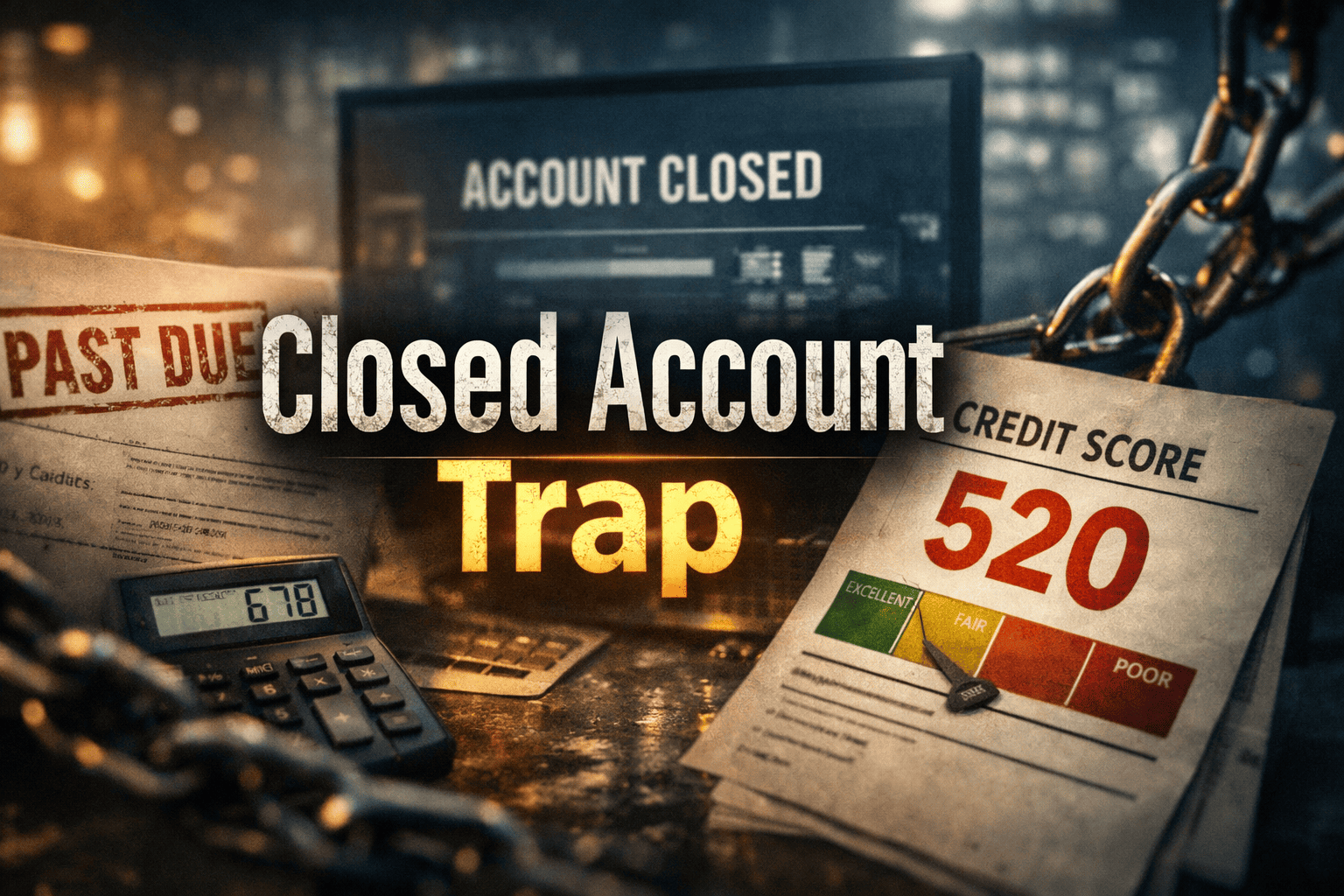
So you finally paid off that credit card. Closed it out. Felt good — like closing a chapter. Then a few months later, you pull your credit report and… those two late payments from years back? Still right there. Still dragging your score down every time a lender takes a look.
Frustrating, right? And way more common than you'd think.
FICO's 2025 data showed roughly 18% of Americans had a 30-day or worse delinquency on their reports. The national average score fell to 715 — dropping for the second year straight — partly because more people are falling behind on cards, auto loans, and personal loans.
Here's the bottom line: yes, late payments on closed accounts absolutely affect your score. And they stick around for up to seven years from the date you missed that payment. But don't panic — let's walk through what's actually happening and what you can do about it.
What Lenders Are Really Looking At
Underwriters don't just glance at your score and call it a day. When a closed account with late payments shows up, here's what grabs their attention:
How bad was it? Big difference between 30 days late once and a 90-day delinquency. FICO's score simulations show someone with a 780+ score can lose 90 to 130 points from a single 30-day late — while a 670 score might only drop 17 to 37 points. The better your track record, the harder you fall.
How recent? A late payment from last year hurts way more than one from five years back. After about 24 months, the sting starts fading.
One-time slip or a pattern? Everybody misses one. But multiple lates across accounts in a short window? That tells a lender you were struggling — not just forgetful.
Who closed it? If you closed the card, that's one thing. If the issuer shut it down after you fell behind, that's a much worse look.
The Score Damage, Broken Down
| How Late | Fair (~670) | Good (~720) | Excellent (~780) |
|---|---|---|---|
| 30 Days | -17 to -37 pts | -60 to -80 pts | -90 to -130 pts |
| 60 Days | -27 to -47 pts | -70 to -100 pts | -100 to -150 pts |
| 90 Days | -27 to -47 pts | -80 to -110 pts | -113 to -160+ pts |
| Charge-Off | -40 to -70 pts | -100 to -140 pts | -130 to -170+ pts |
Source: FICO Score simulations, 2024–2025.
What This Actually Costs You in 2026
Here's where it gets real. Experian's February 2026 mortgage data shows what different scores mean on a $350,000, 30-year fixed mortgage:
| Credit Tier | APR | Monthly Payment | Total Interest (30yr) |
|---|---|---|---|
| 760–850 (Excellent) | ~6.41% | ~$2,190 | ~$438,400 |
| 700–759 (Good) | ~6.63% | ~$2,241 | ~$456,760 |
| 680–699 (Prime edge) | ~6.81% | ~$2,283 | ~$471,880 |
| 620–659 (Subprime) | ~7.42%+ | ~$2,428+ | ~$524,080+ |
That's a $238/month gap between top and bottom — roughly $85,680 extra over the loan. A 2026 AD Mortgage study found that hitting 760 saves borrowers $10,000 to $46,000 depending on state.
And it's not just home loans. Subprime auto rates hit 14–18%. Personal loans with derogatory marks? Often above 20%. Even business funding pulls personal credit now — so that old closed-account late could block the capital you need.
A Quick Example That Puts It in Perspective
Two people apply for a $300,000 mortgage in 2026:
| Sarah (Clean) | James (Late Payments) | |
|---|---|---|
| FICO Score | 760 | 658 |
| Late Payments | None | 90-day on closed Visa |
| APR | 6.41% | 7.42% |
| Monthly Payment | $1,878 | $2,085 |
| Total Interest | $376,080 | $450,600 |
| The Difference | — | +$74,520 |
James pays $207 more every month — and $74,520 extra over the life of his loan. That's a kid's college fund, gone. All from a card he thought was finished.
The 7-Year Rule (Your Light at the End of the Tunnel)
Under Section 605(a) of the FCRA, late payments must come off your report after seven years. That's federal law, enforced by the CFPB and the FTC.
Here's where people get tripped up: the clock starts when you first missed the payment — not when you closed the account, paid it off, or when a collector got involved. Paying the balance doesn't restart or shorten that timeline.
Since payment history is 35% of your FICO score — the single biggest factor — those old marks are actively dragging you down every day they're on your report. TransUnion confirms this works the same whether the account is open or closed.
5 Ways to Fight Back
1. Check for mistakes first. Wrong dates, duplicate entries, marks past the seven-year window — these happen more than you'd think. Dispute directly with Experian, Equifax, and TransUnion.
2. Try a goodwill letter. If you missed a payment because of a real hardship — job loss, medical emergency — write to the creditor and ask them to remove it as a courtesy. Works best when you had a solid history before the slip (10–30% success rate).
3. Let time do its thing. Worst damage is in the first six months. By year two, it fades. By years five to seven, it's barely a factor. After seven, it's gone.
4. Build positive credit fast. Get utilization under 10% — this alone can lift your score in 30–60 days. Pay everything on time. Consider a credit builder loan or getting added as an authorized user on a family member's account.
5. Negotiate pay-for-delete (collections only). Some agencies will remove the mark if you pay. Get it in writing first. Success rates are low (5–15%) but worth a shot.
Myths That Keep People Stuck
"Closing the account erases the late payment." It doesn't. The full history stays for seven years — open or closed.
"I paid it off, so it's clean." The status updates to "paid," but historical late marks stay put.
"BNPL late payments don't matter." They do now. FICO started including Buy Now, Pay Later data in newer scoring models in 2025.
Quick Answers
How long do late payments stay after closing? Seven years from the original missed payment — closure date doesn't matter.
Can they add new late marks to a closed account? Almost never. If you see one, dispute it — it's likely a reporting error.
Fastest way to recover? Get utilization under 10%, keep every payment on time going forward, and dispute anything that looks wrong.
Want to Go Deeper?
- Credit Analysis: How Credit Scores, Debt & Financial Behavior Impact Your Funding Power
- How Credit Scores Really Work and What Affects Your Funding Power in 2026
About the Author
Written by: [Ali Badi] Title: CTO / Credit Risk Strategist Experience: 12+ years in fintech and credit analysis
I've spent over a decade digging into credit reporting mechanics and underwriting decisions. This analysis reflects where things actually stand in 2026 — real data, real lending standards, no fluff.
Disclaimer
This article is for educational purposes only and does not constitute financial, lending, or legal advice. Consult a qualified financial professional before making credit or lending decisions. Data cited is based on publicly available information from FICO, Experian, the CFPB, and other sources as of early 2026 and is subject to change.