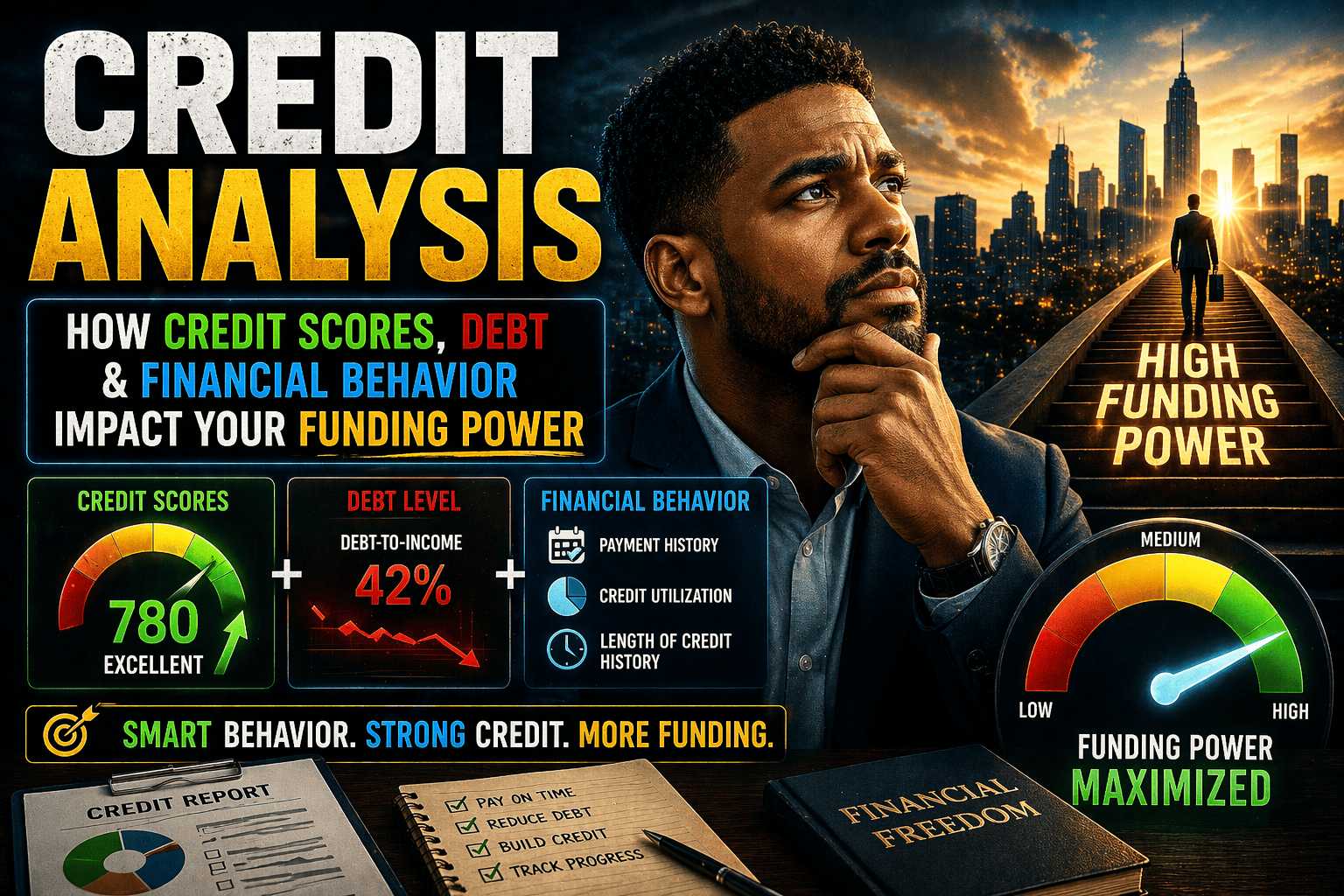
By Ali Badi | CTO / Credit Risk Strategist | Updated 2026
The Rejection Nobody Sees Coming
Let me paint a picture you might recognize.
You've been working on your business plan for weeks. Maybe months. The revenue projections look solid, the documentation is buttoned up, and you walk into that lender meeting — or hit "submit" on that online application — feeling like you've done your homework. Then the letter comes back. Denied. And the reason? Something about your "credit profile not meeting current underwriting standards."
It's a gut punch. And it happens way more often than people talk about.
Here's some context on why 2026 feels harder: FICO reported in April 2025 that the average American credit score dipped to 715. That might sound decent on paper, but the number masks what's really going on underneath. Student loan delinquencies flooded back onto credit reports after years of pandemic pauses. More consumers are slipping past 90 days late on their bills. Lenders are tightening up in response — not because they want to, but because the risk math is shifting.
So what does any of this have to do with you? Everything.
Whether you're chasing an SBA loan, a business line of credit, commercial real estate financing, or just a personal loan to keep things afloat during a rough quarter, credit analysis is the lens through which every lender will judge your application. And I don't mean they glance at your FICO score and flip a coin. They're pulling apart your entire financial story — payment habits, debt structure, utilization patterns, how many times you've applied for credit recently — and building a risk profile from all of it.
The difference between a 660 and a 720? In a real underwriting environment, that can mean $40,000 or more in extra interest on a mid-sized loan. It can mean the difference between walking out with funding and walking out with nothing.
This guide is going to take that whole process apart — piece by piece — so you actually understand what's happening on the other side of that decision. No hype, no "guaranteed approval" nonsense. Just the mechanics, the numbers, and the strategies that actually move the needle.
So What Exactly Is Credit Analysis?
Strip away the jargon and credit analysis comes down to one question: if we lend this person money, what are the odds we'll get it back?
That's it. Every data point, every ratio, every score — they all exist to sharpen the answer to that question. Lenders look at your credit reports from Equifax, Experian, and TransUnion. They factor in your income, your existing debts, what types of credit you carry, and how you've handled all of it over time. Then they run it through a framework built from federal regulations (like the Fair Credit Reporting Act), FICO or VantageScore models, and their own internal risk rules.
None of this is subjective. An underwriter isn't deciding whether they like you. They're running your profile through a scoring engine and seeing where you land.
The Five Things Every Lender Weighs
The specifics vary by loan type and institution, but these five factors drive almost every credit decision:
Payment History — 35% of your FICO Score. This one carries the most weight, and for good reason. If you've consistently paid your bills on time — mortgage, car, credit cards, student loans, all of it — lenders see reliability. If you haven't, they see risk. And the damage from a single slip-up is real. One 30-day late payment can crater your score by 60 to 110 points, though the higher your starting score, the steeper the fall. Someone already sitting at 640 may only drop 20 to 30 points because their score already reflects risk. I've seen borrowers lose financing over a missed cable bill they didn't even know was reported.
Credit Utilization — 30% of your FICO Score. This measures how much of your revolving credit you're actually using. Picture it this way: you've got $10,000 in total credit card limits and you're sitting on $7,000 in balances. That's 70% utilization — and to an underwriter, it screams "this person is stretched thin." Most lenders start flagging you when utilization crosses 30%. Hit 50% and you might trigger an automatic decline before a human even reviews your file.
Length of Credit History — 15%. Longer is better. Lenders want years of data showing that you can manage credit over time. They'll look at the age of your oldest account, the age of your newest one, and the average across all your accounts. If your entire credit history is two years old, there's just not enough to build confidence on.
Credit Mix — 10%. Having different kinds of credit working at the same time — a credit card here, a car loan there, maybe a mortgage — tells lenders you can handle complexity. It's a small factor, but it rounds out the picture.
New Credit Inquiries — 10%. Every time you apply for credit and a lender does a hard pull on your report, it shows up. A few is normal. A dozen in three months makes you look desperate. The one exception: if you're shopping for a mortgage or auto loan and all the inquiries happen within a 14 to 45-day window, most FICO models count them as one.
How the Underwriting Process Actually Works
Behind the Curtain
Most people imagine a loan officer sitting at a desk, flipping through paperwork, and making a judgment call. That's not how it works anymore — at least not at first.
When your application lands, it gets fed into an automated underwriting engine. That system pulls your credit from all three bureaus, merges the data, grabs the middle score, and then starts weighing everything against dozens of variables at once: your score, your utilization, your DTI, how many accounts you have, how old they are, whether anything negative has popped up recently, and more. All of that produces a risk classification — prime, near-prime, subprime — and determines whether your application sails through, gets declined, or gets kicked to a human underwriter for a closer look.
Your Credit Report Is Your Financial Story
Think of your credit report less like a scorecard and more like a biography of how you've handled money. It's got every account you've opened, every payment you've made (or missed), every balance you're carrying, and every collection that's been filed against you. When an underwriter reads it, they're looking for the narrative. Is your profile improving or deteriorating? Are the negative marks old and isolated, or recent and repeated?
I've worked with borrowers who had a 670 on an upward trend — paying down debt, no new negatives — and they got approved over someone with a 710 who'd recently maxed out three credit cards. The score matters, but the story behind it matters too.
Red Flags That Will Get You Flagged
These are the patterns that make automated systems pump the brakes:
- Opening a bunch of new accounts in the last 6 to 12 months
- Aggregate revolving utilization above 50%
- Any delinquency of 60 days or more within the past 24 months
- DTI creeping past 43%
- A credit file that's mostly built on authorized user accounts
- Fewer than three active trade lines (a "thin file")
If your application trips one of these, a human has to look at it. That's not automatically bad — but you need the rest of your profile to tell a convincing story.
What Different Loan Types Expect from You
Every lending product has its own thresholds. These aren't universal rules — a community bank and an online lender might look at the same score very differently — but here's roughly where the 2026 market sits:
| Loan Product | Min. Score | Preferred Score | Max DTI | Typical APR Range | Lender Type |
|---|---|---|---|---|---|
| Conventional Mortgage | 620 | 740+ | 43–45% | 6.5–7.5% | Traditional |
| SBA 7(a) Loan | 680 | 720+ | N/A (cash flow) | 10.5–14.5% | Traditional |
| Business Line of Credit | 660 | 700+ | < 40% | 8–24% | Both |
| Personal Loan | 580 | 700+ | < 40% | 7–36% | Both |
| Auto Loan | 500 | 720+ | N/A | 5–20% | Both |
| Credit Card | 580 | 740+ | N/A | 17–28% | Both |
| Alt. Business Loan | 550–600 | 650+ | Varies | 15–45%+ | Online/Alt |
Note: Ranges reflect early 2026 averages and vary significantly by lender, geography, collateral, and borrower profile. The "Alt. Business Loan" row covers online and alternative lenders, which are where many borrowers under 680 will end up.
What's Different About Lending in 2026
A lot has shifted in the past two years. If you tried to get funding in 2023 and are trying again now, the landscape feels noticeably different.
Student Loan Delinquencies Are Hitting Credit Reports Again
After years of CARES Act forbearance and an additional one-year grace period, federal student loan delinquencies started showing up on credit files in February 2025. The effect was swift. FICO data showed the percentage of consumers with a 90-plus day delinquency shot from 7.4% to 8.3% in a single month — blowing past pre-pandemic levels. Gen Z took the biggest hit, with their average scores dropping three points year-over-year. Makes sense: 34% of younger borrowers carry student debt versus 17% of the overall population. If you're in that group, your credit profile may have taken a hit you didn't expect.
Credit Scores Are Splitting Apart
Here's a trend that doesn't get enough attention. FICO's 2025 Credit Insights report showed that the middle of the credit score distribution — the 600 to 749 range — shrank from 38.1% of the population in 2021 to 33.8% in 2025. The top and bottom brackets both grew. It's a K-shaped split. People with strong credit are doing better. People who were already struggling are falling further behind. And if you're sitting at 650 to 680? You're in no-man's land, where a few points in either direction dramatically change what's available to you.
$1.28 Trillion in Credit Card Debt
That's where Americans stood at the end of Q4 2025, per the Federal Reserve's G.19 Consumer Credit report. Three rate cuts from the Fed in September, November, and December 2024 haven't done much to help — the average APR on accounts carrying a balance was still around 22.3%, and new card offers are averaging 23.8% according to LendingTree. Best-case scenario for excellent credit holders? Rates between 17% and 21%. Fair or poor credit? Expect 25% to 28%, sometimes higher.
Buy Now, Pay Later (BNPL) Is Now on Your Credit Report
This is a major development that many consumers still don't realize. Services like Affirm, Klarna, and Afterpay are now reporting payment data to one or more of the major credit bureaus. That "pay in four" purchase you made six months ago? It may be sitting on your credit file as an active trade line.
Here's why this matters for your credit analysis:
- Each BNPL account can count as a separate trade line, which affects your "new accounts" factor. Five forgotten BNPL plans could look to a lender like you've been opening credit aggressively.
- Some BNPL plans report as revolving credit, which means they factor into your utilization calculation — even for small purchases.
- Late BNPL payments are now being reported the same way a missed credit card payment would be. If you assumed these were low-stakes installments with no credit consequences, that assumption is outdated.
- On the positive side, consistent on-time BNPL payments can help build credit history, especially for thin-file borrowers who don't have many traditional accounts.
If you're preparing for a major loan application, audit your credit reports for any BNPL accounts you may have forgotten about. Close out completed plans and make sure nothing is showing as delinquent.
The Tier System in 2026
| Credit Tier | FICO Range | Typical Card APR | What It Means for Access |
|---|---|---|---|
| Super Prime | 780–850 | 17–19% | You'll get the best of everything |
| Prime | 680–779 | 19–23% | Wide access, solid terms |
| Near Prime | 620–679 | 23–26% | Fewer options, higher costs |
| Subprime | 580–619 | 26–28%+ | Very limited, mostly secured products |
| Deep Subprime | Below 580 | 28%+ or N/A | Rebuilding territory (see section below) |
The Plumbing Behind Your Credit Report
How Data Actually Gets to the Bureaus
Your credit report doesn't update like a bank account balance. Creditors — your card issuers, your mortgage servicer, your auto lender — push data to Equifax, Experian, and TransUnion once a month, usually right around when your statement closes. They transmit it in a standardized format called Metro 2, which is maintained by the Consumer Data Industry Association. That format dictates exactly how your account type, balance, limit, payment status, and any delinquencies get coded.
The Timing Trap Most People Fall Into
Here's where a lot of borrowers get tripped up without realizing it. Say you charge $4,000 on a card with a $5,000 limit during the month, and you always pay it off in full by the due date. Great habit. But if your statement closes before that payment posts, the bureau gets reported an 80% utilization rate — even though you never actually carried a balance. The fix is simple: pay down before the statement close date, not just before the due date. This is especially important in the 60 to 90 days before you plan to apply for anything significant.
Why 10% Utilization Beats 30%
Everyone repeats the "keep it under 30%" advice, and it's not wrong — but it's incomplete. The data consistently shows that borrowers under 10% utilization score higher than those at 25%. And because utilization is a snapshot — it only reflects your most recently reported balance — it's one of the easiest things to manipulate in your favor. Pay everything down before the reporting date and your utilization drops overnight. No waiting months for the effect to kick in.
Fresh Late Payments Do the Most Damage
Payment history is 35% of your score, and timing matters enormously. A 30-day late from six weeks ago is going to punish your score far more than the same delinquency from 2022. Lenders reading your report also distinguish between a one-time mistake on an otherwise spotless record versus a pattern of missed payments across multiple accounts. One says "life happened." The other says "this person can't keep up."
Alternative Data: Beyond the Traditional Five Factors
FICO's traditional five factors are no longer the entire universe of credit scoring. In 2026, more lenders are incorporating non-traditional data into their underwriting decisions, and this trend is opening doors for borrowers who might otherwise fall short.
Experian Boost allows consumers to add on-time utility, phone, and streaming service payments to their Experian credit file. For someone with a thin file or a score in the 620 to 660 range, this can add 10 to 20 points — potentially enough to cross a critical scoring threshold.
Rent reporting services like Rental Kharma and RentTrack can get your monthly rent payments added to your credit file. Given that rent is often the largest monthly expense for non-homeowners, having that consistent payment history reflected on your report can meaningfully strengthen a thin profile.
UltraFICO looks at your banking behavior — savings patterns, account balances, transaction history — to supplement traditional scoring. It's not universally adopted yet, but the direction is clear: lenders want more data, and consumers with responsible financial habits can benefit from providing it.
If your traditional credit file is thin or your score is sitting in the near-prime range, exploring these options before your next application could be the difference between approval and denial.
The Regulatory Picture Right Now
Credit reporting rules keep shifting. In October 2025, the CFPB released a new interpretive rule that basically says federal law has broad authority over credit reporting, preempting most state-level regulations that try to add their own rules. Separately, a court struck down the CFPB's attempt to ban medical debt from credit reports — so properly de-identified medical collections can still appear on your file.
It's also worth acknowledging the broader context: the CFPB itself has been under significant political and structural pressure. Leadership changes, budget disputes, and ongoing court challenges have created real uncertainty about the bureau's future direction and enforcement priorities. For consumers, this means the protections you're counting on today — dispute resolution timelines, data accuracy requirements, limits on what bureaus can report — may evolve in ways that are hard to predict. If you're making major lending decisions, it's worth staying current on regulatory developments, not just credit scores.
Identity Theft and Credit Freezes
You can do everything right with your credit and still see your profile destroyed overnight if someone steals your identity. In 2026, with constant data breaches making headlines, this isn't a hypothetical — it's a risk you need to actively manage.
What to Do Proactively:
- Place a credit freeze at all three bureaus (Equifax freeze, Experian freeze, and TransUnion freeze). It's free, it prevents new accounts from being opened in your name, and you can temporarily lift it when you need to apply for credit yourself.
- Set up fraud alerts. An initial fraud alert lasts one year and requires creditors to take extra steps to verify your identity before opening new accounts.
- Monitor all three credit reports regularly at AnnualCreditReport.com. Look for accounts you don't recognize, addresses you've never lived at, and inquiries you didn't authorize.
If You're Already a Victim:
File an identity theft report at IdentityTheft.gov, which generates an FTC recovery plan. Dispute fraudulent accounts directly with the bureaus using your identity theft report. Under the FCRA, bureaus must block fraudulent information within four business days of receiving a valid report. The recovery process can take months, but catching it early limits the damage and keeps your lending timeline on track.
The Real Dollar Impact of Your Credit Profile
Why a Few Score Points Matter So Much
Credit scoring doesn't work like a dimmer switch — it's more like a light switch with multiple settings. Automated underwriting systems have hard cutoffs. Cross from 679 to 681 and you might jump from near-prime to prime, which unlocks completely different products and rates. Sit one point below a threshold and the system treats you like a fundamentally different borrower.
Putting Actual Numbers to It
Two people walk into the same lender asking for a $250,000 business term loan. Here's what their outcomes look like:
| Factor | Borrower A (Low Risk) | Borrower B (High Risk) |
|---|---|---|
| FICO Score | 740 | 590 |
| Debt-to-Income Ratio | 28% | 52% |
| Credit Utilization | 12% | 74% |
| Delinquencies (24 months) | 0 | 3 (including 1 x 60-day) |
| Approved Rate | 8.5% fixed | 22% variable (if approved) |
| Total Interest (5-year term) | ~$58,000 | ~$162,000+ |
| Collateral Required | Minimal or none | Full personal guarantee + assets |
Over $100,000 in extra interest. Same loan amount. That's not a scare tactic — that's what the math actually produces when your risk classification shifts.
A Realistic Rebuilding Timeline
If your profile is in rough shape, here's the playbook that actually aligns with how scoring engines recalculate:
Months 1–3: Get utilization under control. Pay revolving balances below 30% — below 10% if you can swing it. This moves the fastest because utilization resets every billing cycle.
Months 3–6: Stack clean months. Every on-time payment adds weight to the most important component of your score.
Months 6–12: Stop applying for things. Let those hard inquiries age out. They lose most of their bite after six months.
Months 12–24: Deal with collections and errors. Try pay-for-delete negotiations. File disputes on anything that's inaccurate. The FCRA gives you the right to challenge information you believe is wrong.
DTI: The Number Nobody Talks About Until It Kills Your Application
Everyone obsesses over their credit score. Almost nobody pays attention to their debt-to-income ratio until a lender tells them it's too high. DTI is simply the percentage of your gross monthly income that goes toward minimum debt payments — and if it's over the lender's limit, your score almost doesn't matter.
Two Flavors of DTI
Front-end DTI only looks at housing costs — your mortgage payment, property taxes, insurance, HOA. Most conventional mortgage lenders want this under 28% to 31%. Back-end DTI stacks everything on top: credit cards, car payments, student loans, personal loans — the whole picture. For conventional loans, the ceiling is usually 43% to 45%. Some government-backed programs stretch higher if you've got compensating factors, but don't count on it.
Business Owners Aren't Off the Hook
If you're applying for an SBA 7(a) loan or a conventional business loan with a personal guarantee, your personal DTI gets scrutinized just like a consumer loan. Most SBA lenders want it under 40%. Some banks cap it at 35%. They'll also look at your business's debt service coverage ratio — net operating income divided by total debt service. You want that at 1.25 or better, meaning your business earns 25% more than its debt payments require.
Credit Card Debt Weighs More Than a Mortgage
Not all debt looks the same to an underwriter. $50,000 in mortgage and auto debt with clean payments? That's manageable, predictable, secured debt. $20,000 in maxed-out credit cards? That's volatile, unsecured, and it tells the lender you might be living beyond your means. Revolving debt always raises more concern than installment debt in a credit analysis.
Myths That Are Costing You Points
Bad credit advice is everywhere, and some of it sounds completely reasonable until you understand how scoring actually works.
"Close your old cards to clean up your credit." Don't. You're killing available credit, which spikes your utilization. You're also shortening your account age over time. Unless you're paying an annual fee that makes zero sense, leave old cards open.
"Checking your credit will lower your score." It won't. Checking your own score is a soft inquiry — invisible to scoring models. Only hard pulls from actual loan or credit card applications affect your number, and even those typically cost just 3 to 5 points.
"I paid off that collection, so my score should bounce back." Under FICO 8 — still the most commonly used model — a paid collection is still a negative mark. FICO 9 and newer VantageScore models ignore paid collections, but you don't get to choose which model your lender runs.
"I just have one credit score." You've got dozens. FICO publishes over 50 industry-specific models. Your mortgage lender pulls different versions than your auto lender, and the free score on your banking app might be 20 to 40 points off from what a lender sees.
"My income helps my credit score." Income isn't on your credit report. It's not part of the scoring calculation at all. Lenders verify it separately to calculate DTI, but your paycheck has zero direct connection to your FICO number.
"Co-signing is no big deal." That loan shows up on your report in full, as if you borrowed every penny yourself. It hits your utilization, your DTI, and if the other person pays late? Your score takes the damage.
Staying on Top of Your Credit — Not Just Checking It
Knowing your score is step one. Doing something useful with that knowledge is step two — and it's the step most people skip.
FICO says 71% of Americans check their scores multiple times a year. Nearly half of younger consumers do it monthly. That's great. But looking at a number on a screen without understanding what's driving it — or what you can do about it — doesn't accomplish much.
The Things That Actually Matter to Track
- Utilization on every card and in total. Keep it under 30%. Under 10% is where the real scoring advantage lives.
- Hard inquiry count. Be intentional about when and how often you apply for credit.
- How old your negative marks are. Their impact fades — knowing when gives you better timing for major applications.
- Authorized user accounts. Someone else's spending habits are showing up on your file. Make sure that's helping, not hurting.
- Errors across all three bureaus. Pull your reports annually at AnnualCreditReport.com. Disputes over legitimate mistakes can produce results in 30 to 45 days.
- BNPL accounts you may have forgotten about. These are now showing up as trade lines and can affect your new accounts factor and utilization.
The 90-Day Pre-Application Playbook
Got a big funding application coming up? Start preparing at least 60 to 90 days out. Pay card balances down before statement close dates so low utilization gets reported. Put a freeze on new credit applications. File disputes on anything inaccurate. Make absolutely sure every account is current. The snapshot the lender pulls should be the single best version of your credit profile — and you have more control over that timing than you probably think.
Starting from Deep Subprime: A Path Forward
If your score is below 580, most of the advice in this guide might feel out of reach. Traditional lenders aren't going to approve you for an SBA loan or a conventional mortgage right now — and pretending otherwise would be dishonest. But "below 580" doesn't mean "out of options." It means you need a different playbook.
Where to Start:
- Secured credit cards are the most reliable entry point. You put down a deposit (typically $200 to $500) that becomes your credit limit. Use the card for small purchases, pay it off every month, and you're building positive payment history from day one.
- Credit builder loans, offered by many credit unions and online lenders like Self, work in reverse — you make payments into a savings account, and the lender reports those payments to the bureaus. When the loan term ends, you get the money back.
- Becoming an authorized user on a family member's account with a long, clean history can add positive data to your file. Just make sure the primary cardholder has low utilization and no late payments — otherwise you're importing their problems.
- Community Development Financial Institutions (CDFIs) specialize in lending to underserved borrowers. They often have more flexible underwriting criteria than traditional banks and can provide small business loans, microloans, and financial coaching.
The goal at this stage isn't to get a perfect score overnight. It's to establish a pattern of responsible credit use so that in 12 to 24 months, you've moved out of deep subprime and into a range where more products become available.
Frequently Asked Questions
How long do negative items stay on a credit report? Seven years for most things — late payments, collections, charge-offs. Bankruptcies hang around for seven to ten years. But the scoring damage peaks early and fades steadily. Most of the recovery happens in the first 24 months.
Will my score be different at each bureau? Probably. Creditors don't always report to all three, so each bureau may have slightly different data on you. A 10 to 30 point spread across Equifax, Experian, and TransUnion is completely normal. Mortgage lenders handle this by pulling all three and using the middle score.
How fast can I realistically raise my score? Paying down utilization is the quickest win — one or two billing cycles. Building payment history takes three to six months of consistency. Coming back from a bankruptcy or foreclosure? Two to four years of steady rebuilding to reach prime range.
Hard inquiry vs. soft inquiry — what's the actual difference? Hard inquiries happen when you apply for credit. They cost about 3 to 5 points and linger for two years (though they mostly stop mattering after six months). Soft inquiries — checking your own score, pre-approval checks, employer screenings — don't affect your score at all.
My personal credit is under 680. Can I still get a business loan? Traditional SBA lenders usually want 680 at minimum. But alternative and online lenders may go down to 580 — with higher rates and shorter terms. Strong business cash flow can sometimes offset a weaker personal score, depending on the program.
Does my credit card utilization matter for business loan applications? Very much. High personal utilization signals over-leverage, and business lenders take notice. Anything above 30% can hurt your approval odds and drive up the rate they offer. Paying down balances before applying is one of the highest-impact moves available to you.
Which FICO model are lenders using in 2026? Most general consumer lenders rely on FICO Score 8. Mortgage lenders still use older models — FICO 2 (Experian), FICO 4 (TransUnion), FICO 5 (Equifax) — though the industry is gradually migrating to newer versions. FICO says their scores power 90% of top U.S. lending decisions.
Do BNPL payments affect my credit score? Yes. Major BNPL providers like Affirm, Klarna, and Afterpay now report to credit bureaus. Each plan can count as a trade line, and missed payments are reported just like any other delinquency. On-time BNPL payments can help build history, but forgotten or delinquent accounts can hurt your profile.
Sources Referenced in This Guide
- FICO: "Average U.S. FICO Score Drops to 715" (April 2025) — cited for average score data in the introduction and lending context. FICO Score Credit Insights Report (September 2025) — cited for the K-shaped credit score distribution shift. FICO blog on student loan delinquencies — cited for the 7.4% to 8.3% delinquency spike.
- Experian: Average Credit Score in the U.S. — historical score trends, generational comparisons, and five-year credit trend analysis through September 2025.
- Consumer Financial Protection Bureau (CFPB): FCRA Preemption Interpretive Rule (October 2025) — cited in the Regulatory section. FCRA Compliance Resources and 2026 Lending Threshold Adjustments.
- Federal Reserve: Consumer Credit Report (G.19) — $1.277 trillion in credit card debt (Q4 2025). Quarterly rate data and federal funds rate decisions from September, November, and December 2024.
- LendingTree: 2026 Credit Card Debt Statistics — new card APR of 23.77% (early 2026) and delinquency analysis.
About the Author
Written by: Ali Badi Title: CTO / Credit Risk Strategist Experience: 12+ years in fintech, credit analysis, and lending technology
Ali Badi has spent the better part of two decades building the systems that power credit decisions — underwriting engines for fintech companies, risk models for banks, scoring frameworks for alternative lenders. This isn't theory. It comes from sitting on the other side of the desk, reviewing thousands of real applications, and seeing firsthand what gets funded and what doesn't. When it comes to the FCRA, ECOA, and the mechanics of how lending actually works, Ali doesn't just study it — he builds it.
Disclaimer: This article is for educational purposes only. It's not financial advice, legal counsel, or a lending recommendation. Your results will depend on your specific circumstances, the lender you work with, and current market conditions. The data here reflects the 2026 lending environment as of publication and may change. Talk to a qualified financial advisor before making any major credit or funding decisions.