
Trying to figure out how much you'll pay for homeowners insurance on a $150,000 house can feel tricky. But, we can start with a simple, general idea. For a house this size, you can expect to pay somewhere between $1,500 and $2,400 per year.
That's about $125 to $200 a month. Just remember, this is only a starting guess. The final price on your insurance paper will be special for you, your house, and a few other important things.
Understanding Homeowners Insurance
So, what is homeowners insurance? Think of it like a safety net for your biggest investment—your home. If something bad happens, like a fire or a big storm, your insurance helps pay for the repairs. This is super important because without it, you'd have to pay for everything yourself, which could cost a lot of money.
This protection is why having homeowners insurance is a smart move. It gives you peace of mind, knowing you won't lose everything if there's an accident.
Basic Coverage Types Explained
Your insurance policy is made up of a few different parts that protect you in different ways. Here are the main ones:
Dwelling Coverage: This pays to fix or rebuild your house if it gets damaged.
Personal Property Coverage: This helps you replace your things inside the house, like furniture and clothes, if they are stolen or destroyed.
Liability Protection: This helps if someone gets hurt on your property and you have to pay their medical bills.
Additional Living Expenses: If you can't live in your home while it's being repaired, this part helps pay for a temporary place to stay, like a hotel.
Knowing these parts helps you see what your money is paying for.
How Much is Homeowners Insurance?
The average price is a good place to start, but your own price will be unique. Insurance companies look at many details to figure out how likely it is that you'll need to use your insurance. This is why it’s a great idea to ask for prices from different companies. One company might charge you more for an old roof, but another might give you a discount for a new security system.
Average Costs for a $150,000 House
Let’s look at some real numbers. Data shows that the average cost to insure a $150,000 house is around $2,357 a year. That’s about $196 a month. But this number can change a lot from one company to another.
For example, you might get a price of $2,246 from one company and over $2,582 from another for the same house. That’s a difference of over $300 a year!
This table shows how prices can be different:
Insurance Company | Average Annual Premium |
|---|---|
$2,246 | |
$2,357 | |
$2,434 | |
$2,582 |
As you can see, shopping around can save you real money. Knowing your insurance cost is important when buying a home because it's usually part of your monthly house payment. You can use a free mortgage calculator to see how insurance will affect your total monthly bill.
Factors Influencing Insurance Rates
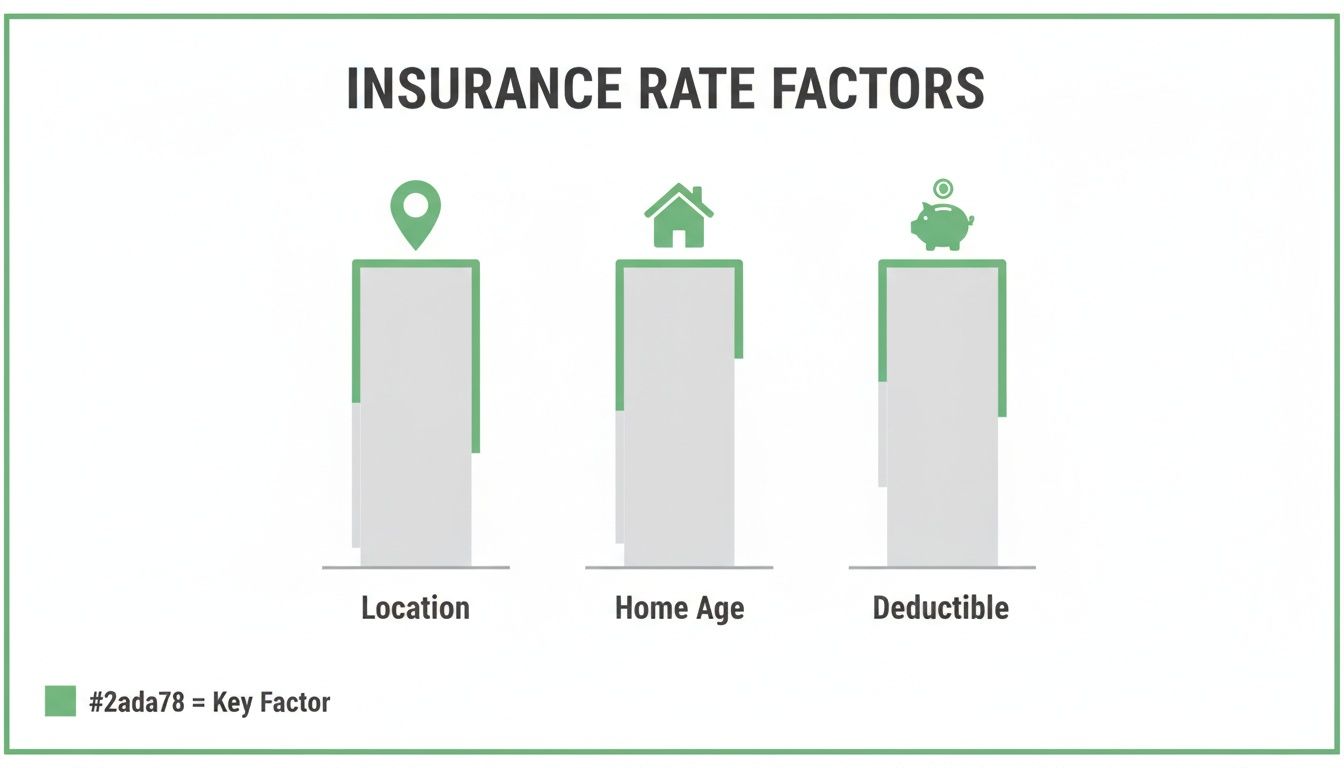
So, why do prices change so much? Here are the biggest reasons:
Your Home's Location: If your house is in a place with lots of storms, like hurricanes or tornadoes, the price will be higher.
The Age and Condition of Your House: An older house with an old roof or old wiring is seen as more risky, so it costs more to insure.
Your Personal Claims History: If you have used your insurance a lot in the past, companies think you might again, and they will charge you more.
The Insurance Company You Choose: Every company has its own way of calculating prices, which is why their numbers are different.
Using a Home Insurance Calculator
Before you start calling insurance agents, there's an easier way to get an idea of your cost. A home insurance calculator is an online tool that gives you a quick guess of what you might pay. Think of it as a first step.
How to Use a Home Insurance Calculator
Using a cost estimator is simple. The website will ask you a few easy questions to give you a good guess on your homeowners insurance cost.
You'll need to share:
Your Home's Address: This is the most important part. The calculator uses your location to think about local risks, like weather.
Home Details: You'll need to know when your house was built, how big it is, and what it's made of (like brick or wood).
Safety Features: Be sure to mention things like smoke detectors or a security system. These can lower your estimated cost.
Your Basic Information: Things like your birthday help the tool make the guess more personal for you.
Once you put in the information, the calculator gives you an instant estimate.
Benefits of Using a Cost Estimator
The best thing about a homeowners insurance cost estimator is that it gives you control. You can see how changing things, like your deductible (the amount you pay first in a claim), affects the price. This helps you find a good balance between a low monthly payment and what you can afford to pay if something happens.
These tools are great for making smart financial choices. For example, if you wanted to start a business, a funding calculator could show you what you can afford. Knowing these numbers gives you the confidence to move forward.
Regional Variations in Homeowners Insurance
Where you live is one of the biggest things that decides your insurance price. A house in a place with lots of bad weather will cost more to protect than a house in a calm area.
How Much Is Homeowners Insurance in Florida?
Florida is one of the most expensive states for home insurance. Because of hurricanes and flood risks, the average cost can be over $4,000 a year. The high chance of big storms means insurance companies have to charge more to cover the damage.
Homeowners Insurance Costs in PA and NC
States like Pennsylvania (PA) and North Carolina (NC) are usually less expensive than Florida but have their own risks. In PA, winter storms are a concern, while NC has to worry about hurricanes on its coast. The average cost in these states is often closer to the national average, but it depends on exactly where you live.
Comparing Rates in NJ and CA
New Jersey (NJ) faces risks from coastal storms, while California (CA) has to deal with wildfires and earthquakes. Because these risks are so different, their insurance prices are too. A $150,000 house in a wildfire-prone part of California will have a very different insurance bill than one in a quiet New Jersey town.
Here’s a quick look at how much prices can change by state:
State | Average Annual Premium | Main Risk |
|---|---|---|
Florida | $4,331 | Hurricanes, Flooding |
PA | $935 | Winter Storms, Flooding |
NC | $1,487 | Hurricanes, Wind |
NJ | $1,107 | Coastal Storms |
CA | $1,385 | Wildfires, Earthquakes |
Tips for Reducing Homeowners Insurance Costs

The good news is you can do things to lower your insurance bill. You don't have to just accept the first price you see. Insurance companies will often give you a better price if you make your home safer.
Discounts and Savings Opportunities
You can get discounts for simple things. Most companies will lower your price if your home is safer from fires or theft.
Think about adding these:
Smoke Detectors: Having smoke detectors is a basic safety step that almost always gets you a small discount.
Home Security System: A security system that calls the police or fire department for you can lower your price.
Utility Upgrades: In an older home, updating the wiring or pipes can reduce the risk of fire and water damage, which can also lower your cost.
Bundling Policies for Better Rates
One of the easiest ways to save money is to bundle your insurance. This just means you buy your home and car insurance from the same company. Companies want to have more of your business, so they will often give you a big discount, sometimes up to 25% off.
It’s a simple way to save hundreds of dollars a year. You can see a full breakdown of how bundling works to learn more.
Improving Home Safety to Lower Premiums
Taking steps to protect your home can lead to real savings. Things like a new roof or storm shutters show the insurance company that you are serious about preventing damage. Always tell your insurance agent when you make these improvements.
Your credit score can also play a role. A better score can sometimes lead to lower insurance prices. You can learn more about improving your credit readiness to help you get the best rates. By being smart and safe, you can find a great price for the protection you need.
Interesting Facts to Consider
The cost of homeowners insurance differs across states.
Florida is known for having particularly high rates.
Using home insurance calculators may help you save money.
The average cost of insurance can vary greatly depending on the value of the home.
Combining insurance policies frequently leads to cost savings.
Frequently Asked Questions
What factors influence homeowners insurance costs?
Homeowners insurance costs are influenced by various elements, including the property's location, age, and condition, the coverage amount, and the homeowner's claims history. Other factors such as security features and local weather conditions also play a role.
How can I estimate my homeowners insurance?
To estimate your homeowners insurance, consider the value of the property, the cost to rebuild, and any additional coverage you may need. Online calculators and consultation with insurance agents can provide more precise estimates.
What is the average cost of homeowners insurance in Florida?
In Florida, the average cost of homeowners insurance can vary significantly based on location and other factors, but it usually ranges around $1,500 to $3,000 annually.
How does location affect insurance rates?
Location affects insurance rates due to factors such as crime rates, susceptibility to natural disasters, and the proximity to emergency services. Coastal areas, for example, may have higher rates due to the risk of hurricanes.
Are there discounts available for homeowners insurance?
Yes, there are several discounts available for homeowners insurance. These can include discounts for having security systems, bundling policies, or maintaining a claims-free history. It's advisable to check with your insurance provider for specific discounts they offer.
Your credit plays a big role in getting the best rates on both your mortgage and your insurance. Score Machine uses AI-powered analysis to provide a clear, actionable plan to understand and strengthen your credit file before you seek funding. Stop guessing about your financial future and find out how prepared you really are. Learn more at thescoremachine.com.