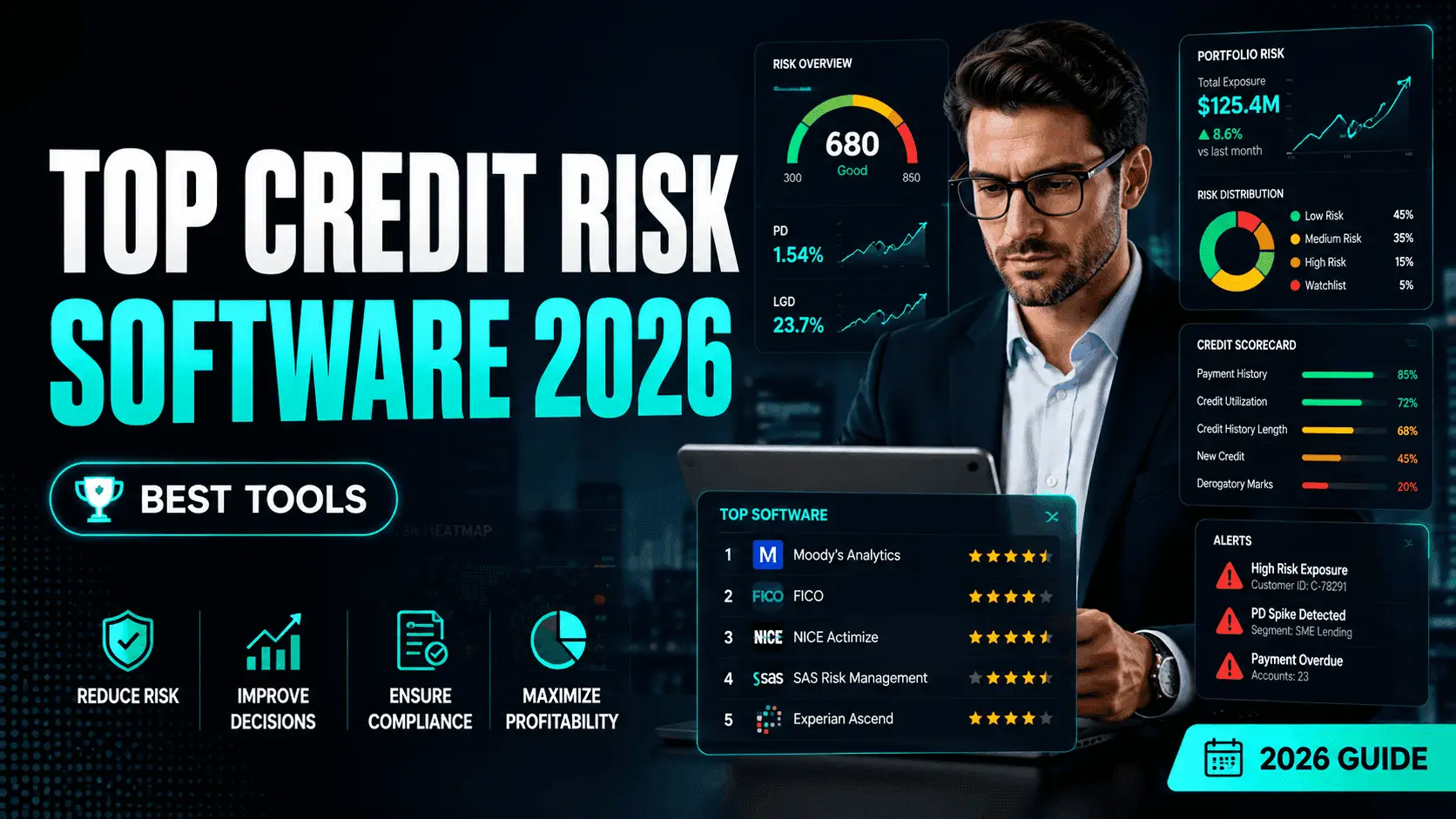
Credit risk management software helps credit teams evaluate, monitor, and manage credit exposure across their entire commercial portfolio without relying on spreadsheets and manual checks. These platforms pull data from external credit ratings, internal models, and market views into one place so your team can make confident decisions faster. The market for these tools hit $4.1 billion in 2025 and is projected to reach $10.7 billion by 2030. But here’s the thing most articles won’t tell you: not every credit team needs a full-scale platform. Some teams just need timely, reliable credit data. I’ve spent over five years in credit analysis and risk assessment, and in this guide I’ll break down what actually matters when choosing these tools.
Why Credit Teams Are Moving Away from Manual Processes
Let me be direct. If your credit professionals are still running exposure checks in Excel and pulling bureau reports one by one, you’re already behind. I’ve worked with teams that were spending 8–10 hours a week just compiling data that software could aggregate in minutes.
The operational challenges are real:
- Visibility gap: You can’t see risk you can’t measure. When your data lives in five different places, deterioration in a borrower’s profile slips through the cracks.
- Coverage gap: Traditional agencies only cover about 10% of the entities most commercial lenders deal with. The other 90% are unrated—and that’s where the real risk hides.
- Exposure tracking breaks down at scale. Once you’re managing hundreds of counterparties across multiple products, manual tracking isn’t just slow—it’s dangerous.
- Regulatory examination preparedness suffers. Examiners want documented evidence of your risk processes. “We check the spreadsheet monthly” doesn’t cut it under SR 11-7 validation guidance.
This isn’t about chasing technology for its own sake. It’s about building a defensible, scalable credit operation. That’s why credit risk management software has moved from “nice to have” to “must have” for mid-to-large credit teams.
What Credit Risk Management Software Actually Does
At its core, this category of software serves one purpose: give your team a single, real-time view of credit risk across your book. Here’s what that looks like in practice:
1. Aggregating Credit Intelligence
Good platforms pull external credit ratings, internal ratings, PD estimates, and market views into one dashboard. No more toggling between three vendor portals and a shared drive. The best systems also incorporate external reference points so you can benchmark against peer banks and see where your assessments might be too optimistic.
2. Automating Workflows
Automation and integrated workflows are where the real time savings come in. Think automatic alerts when a borrower’s credit profile drops by two or more notches, scheduled portfolio reviews, and streamlined approval routing. I’ve seen teams cut their review cycle time in half just by eliminating the back-and-forth email chains.
3. Regulatory and Compliance Support
With Basel IV introducing a 72.5% output floor on internal models, institutions need to demonstrate that their internal models are well-calibrated against external data. Credit risk management platforms that include external benchmarking give you the documented evidence regulators expect—and that examiners will ask for.
4. Portfolio-Level Visibility
This is the one most teams underestimate. Knowing individual borrower risk is one thing. Understanding concentration, sector exposure, and correlation risk across your entire portfolio is where real capital efficiency comes from. Data-first solutions give you that visibility without the cost and complexity of full-scale platforms.
The Five Types of Credit Risk Software You’ll Encounter
Not all tools are the same. The market breaks into distinct solution categories, and understanding them saves you from buying the wrong thing. Here’s how I categorize the vendor categories:
| Category | What It Does | Best For | Limitation |
|---|---|---|---|
| Consensus Data Aggregators | Aggregate PD estimates and risk scores from multiple contributors | Benchmarking internal ratings against peer banks | Limited coverage of private companies |
| Traditional Agency Platforms | Deliver ratings and research from S&P, Moody’s, Fitch | Regulated institutions needing recognized ratings | Only cover ~10% of commercial counterparties |
| Quantitative Models | Use publicly traded equity and financial data to generate PD estimates | Portfolios with 70–80% publicly traded counterparties | Structural limitations with private company portfolios |
| Enterprise Risk Platforms | Full lifecycle credit management with workflow automation | Large institutions with complex approval chains | High cost, long implementation, rigid customization |
| Integrated Data Platforms | Combine credit data from multiple sources with monitoring and alerts | Mid-market teams needing visibility without enterprise complexity | May require integration work with existing systems |
The strategic question isn’t which vendor is best overall—it’s which category addresses your specific gap. A team drowning in unrated counterparties has a different problem than a team struggling with workflow bottlenecks.
The Unrated Entity Problem: Where Most Tools Fall Short
This deserves its own section because it’s the single biggest pain point I see in the field.
Traditional agencies cover roughly 10% of the entities in a typical commercial portfolio. Quantitative approaches that rely on publicly traded equity data can extend coverage to maybe 70–80%—but only if your book is heavy on public companies. For private company portfolios, you’re looking at serious structural limitations.
This is the unrated entity problem, and it’s why many credit teams still have a massive visibility gap even after investing in expensive software. The solution usually involves combining tools—complementary functions from different vendor categories—rather than expecting one platform to solve everything.
From my experience, the most effective approach is layering: use a consensus data aggregator for external benchmarking and peer validation, add a quantitative model for your publicly traded names, and fill the remaining gaps with a standalone data solution that covers the private and mid-market entities your other tools miss.
What to Actually Look for When Evaluating Credit Risk Software
After helping organizations evaluate these tools, here’s my shortlist of what actually matters:
Coverage Over Flash
A beautiful dashboard means nothing if the platform only covers 30% of your book. Ask every provider: “How many of my specific counterparties can you actually rate?” Demand a trial with your real data.
Integration With Your Stack
Most credit teams already use CRMs, ERPs, and procurement platforms. Your credit risk tool needs to plug into what you already have, not replace it. Look for API access, standard data formats, and pre-built connectors.
Regulatory Alignment
If you’re subject to Basel IV or SR 11-7, make sure the platform supports external benchmarking and produces the documented evidence your examiners need. This isn’t optional—it’s a compliance requirement.
Scalability for High Transaction Volumes
Organizations with high transaction volumes need tools that can enforce credit policies at scale without slowing down approvals. If your team processes hundreds of credit decisions per week, you need real-time scoring, not batch overnight updates.
Total Cost of Ownership
Don’t just compare enterprise software licenses. Factor in implementation time, training, ongoing data fees, and the internal IT resources you’ll need. Some of the most expensive tools I’ve seen deployed were the cheapest on paper because nobody budgeted for the 6-month integration project.
Where a Tool Like Command Credit Fits In
Command Credit is one example of a standalone data solution that takes a different approach than the big enterprise platforms. Rather than trying to be your entire risk management toolkit, it focuses on being the credit risk management software tool that delivers timely, reliable credit data your team needs to make confident decisions.
It’s built for mid-to-large credit teams who need to evaluate, monitor, and manage credit exposure without the overhead of a full enterprise deployment. It integrates with existing CRMs, ERPs, and procurement platforms—which matters for organizations with high transaction volumes that need to enforce credit policies at scale.
I mention it not as a blanket recommendation but as an illustration of where the market is heading: away from monolithic enterprise suites and toward focused, data-first solutions that address institutional gaps without requiring enterprise software licenses or year-long rollouts.
The Competitive Landscape: How to Benchmark Your Options
When shopping for credit risk management software, you’re essentially choosing between depth and breadth. Here’s how the main competitors stack up by focus area:
| Focus Area | What to Compare | Key Question |
|---|---|---|
| Data coverage | Number of rated entities vs. your actual portfolio | What % of my book can this tool actually cover? |
| Benchmarking | Peer bank data, consensus estimates, external reference points | Can I validate my internal ratings against real peer data? |
| Workflow automation | Approval routing, alerts, review scheduling | Will this reduce my team’s manual workload by 50%+? |
| Regulatory support | Basel IV alignment, SR 11-7 documentation, audit trails | Will this satisfy my examiners? |
| Integration | API access, CRM/ERP connectors, data export formats | Does this work with what I already have? |
Run a benchmarking exercise with at least three providers using your actual portfolio data. The demo environment always looks great; it’s your real data that exposes the coverage gap.
My Recommendations Based on Team Size and Maturity
Small Credit Teams (1–5 Analysts)
You probably don’t need an enterprise platform yet. Start with a solid standalone data solution that gives you timely, reliable credit data and basic monitoring. Get your data house in order before you invest in workflow automation.
Mid-Size Teams (5–20 Analysts)
This is the sweet spot for integrated data platforms. You need visibility across your portfolio, some workflow automation, and the ability to produce reports for regulatory examination preparedness. Tools like Command Credit are designed for this segment.
Large Institutional Teams (20+ Analysts)
You likely need a combination: an enterprise risk platform for workflow management plus one or more data-first solutions to close coverage gaps. Budget for integration and expect a 6–12 month rollout.
Basel IV, SR 11-7, and Why This Matters Now
The regulatory environment is tightening. Basel IV’s 72.5% output floor means institutions using internal models can no longer stray too far from standardized approaches. This puts direct pressure on credit risk professionals to demonstrate that their PD estimates are well-calibrated.
SR 11-7 validation guidance requires documented evidence of model performance, including external benchmarking. If your examiners ask to see how your internal ratings compare to external reference points and you can’t produce that analysis quickly, you have a problem.
This is where credit risk management software with built-in external benchmarking pays for itself. It’s not just about better financial decisions—it’s about regulatory examination preparedness and avoiding costly findings.
Frequently Asked Questions
What is credit risk management software?
Credit risk management software is a category of tools that helps credit teams evaluate, monitor, and manage credit exposure across their portfolio. These platforms aggregate data from external credit ratings, internal models, and market views to support faster, more informed financial decisions. They range from standalone data solutions to full enterprise risk platforms.
How much does credit risk management software cost?
Costs vary widely. Standalone data solutions can run $2,000–$10,000 per month depending on portfolio size and data feeds. Enterprise risk platforms typically start at $100,000+ per year in licensing alone, with implementation costs adding another 50–100% on top. Always calculate total cost of ownership including integration, training, and ongoing data fees.
Do small credit teams need credit risk management software?
Even small teams benefit from replacing manual spreadsheet processes with a focused data tool. You don’t need a full enterprise platform, but having timely, reliable credit data in one place reduces risk and saves hours of manual work each week. Start with a standalone data solution and scale up as your team grows.
What is the unrated entity problem in credit risk?
The unrated entity problem refers to the fact that traditional credit rating agencies only cover about 10% of commercial counterparties. The remaining 90% have no external rating, creating a visibility gap that forces credit teams to rely on limited internal assessments or manual research. Integrated data platforms and consensus data aggregators help close this gap.
How does Basel IV affect credit risk software selection?
Basel IV introduces a 72.5% output floor on internal models, meaning institutions must benchmark their PD estimates against standardized approaches. This makes external benchmarking capabilities essential in any credit risk management software. Tools that support SR 11-7 validation guidance and produce documented evidence of model calibration are now a regulatory necessity, not a luxury.
Can credit risk management software integrate with existing CRMs and ERPs?
Most modern platforms offer API access and pre-built connectors for popular CRMs, ERPs, and procurement platforms. Integration capability should be a top evaluation criterion, especially for organizations with high transaction volumes. Ask vendors specifically about their integration with your existing stack before committing.
About the Author
Ali Badi is the CEO and Credit Risk Strategist at ADR Wealth Advisor, with over five years of hands-on experience in credit analysis, risk assessment, and funding readiness consulting. He is the creator of The Score Machine (thescoremachine.com), an AI-powered credit analysis platform serving credit professionals, consultants, loan officers, and funding brokers. This article reflects practitioner experience, not theoretical knowledge.